The Candle in the Cabinet: Kempelen's Turk and the Chess-Playing Machine
In 1770 a cabinet with a chessboard beat the challengers at Schönbrunn. Its doors showed gears; inside, by candlelight, a man was playing.
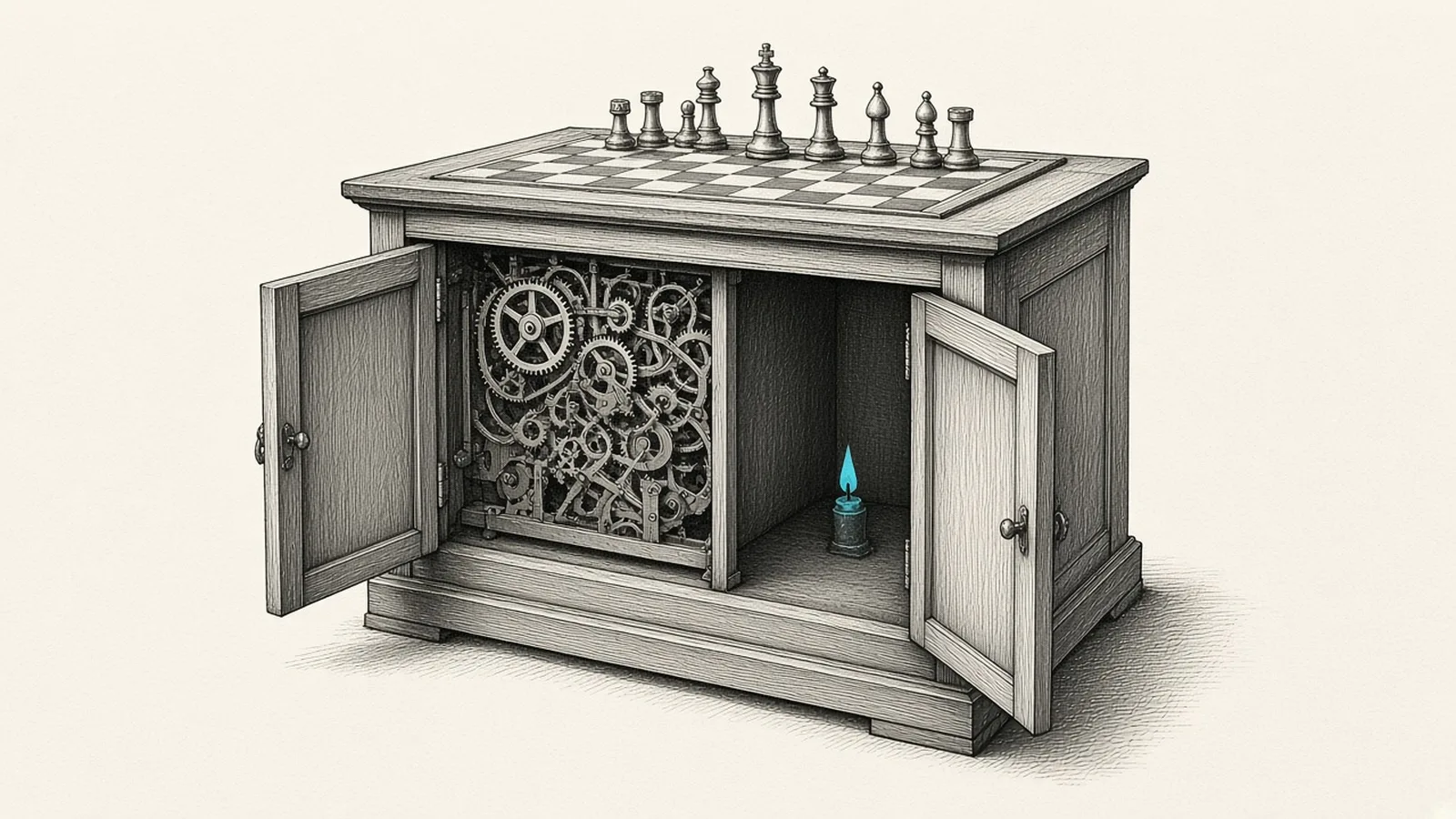
In the spring of 1770, at Schönbrunn Palace, Wolfgang von Kempelen kept a promise made to Empress Maria Theresa. The year before, a French illusionist, François Pelletier, had enchanted the court; Kempelen had said he would come back within a year with something better. He came back with a wooden cabinet just over a metre long, a chessboard on its lid and, seated behind it, a life-sized figure dressed as an oriental sorcerer, its left arm resting on a cushion. They called it the Turk.
Before each game Kempelen opened the doors. On the left you saw gears and cogwheels, as in a clock; with the back open too, you could look straight through the machine. Then he closed it, wound the mechanism and invited someone to sit down. The first was a courtier, Ludwig von Cobenzl. He lost, like the other challengers that day.
The open doors
There was a man inside. The secret lay not in the gears but in how they were staged. The visible clockwork reached only a third of the way into the cabinet; a sliding seat let the person inside move while the doors were opened one at a time. Every piece on the board had a magnet in its base, which drew up a magnet hanging on a string beneath the board: that is how the hidden player saw the opponent's moves. He moved the figure's arm with a pantograph, over a second chessboard, by the light of a candle.
The Turk toured Europe and then America for eighty-four years. In 1783, in Paris, it played Benjamin Franklin; in 1809, again at Schönbrunn, according to accounts that do not agree, Napoleon. Many suspected a trick; nobody described it accurately while the machine existed. In 1784 Karl Gottlieb von Windisch told of an old lady who, during a demonstration, went and hid in a window seat, as far as she could from the evil spirit she believed possessed the cabinet. In 1836 Edgar Allan Poe devoted a famous essay to it, full of wrong hypotheses.
Artificial artificial intelligence
On 5 July 1854 a fire that started at the National Theatre in Philadelphia reached the museum where the Turk lay forgotten in a corner, and destroyed it. Silas Mitchell, son of its last owner, arrived too late; he wrote that he had heard through the flames the last words of their friend, "échec! échec!", the voice added by Johann Nepomuk Mälzel, who had bought it after Kempelen's death. Three years later, precisely because the machine was gone, Mitchell published in The Chess Monthly the first full explanation of the mechanism.
The myth did not end in the fire. In 2005 Amazon gave the name Mechanical Turk to a service in which companies and programs handed people scattered around the world small tasks that computers could not yet do economically: spotting an object in an image, writing a description, answering a survey. Amazon called the process "artificial artificial intelligence". The service closed on 30 September 2026.
It is no accident that the name has held for two centuries. The Turk is not the story of a machine that thought, but of a cabinet designed to make us look the wrong way: the gears in full light, the person in the dark. Like the bronze Talos, who had a single vein closed by a nail, this automaton too has one precise point where the marvel turns into human work. There, a candle was burning, and someone was keeping it away from the cracks.
Sources: Mechanical Turk, Wikipedia, and the sources it cites (Windisch 1784, Poe 1836, Mitchell 1857, Standage 2002); Amazon Mechanical Turk, Wikipedia (accessed 25 November 2026).
> ln -s ./linked-nodes
- [PART OF] Technological Mythology
- [RELATED] When Technology Becomes Myth
- [RELATED] The Stud in the Ankle: Talos, the Bronze Guardian of Crete