Understanding the Orbit by Playing: Gravity in Two Dimensions
A plane, a star, a body thrown sideways: two-dimensional gravity teaches the orbit with the hands, before the formulas.
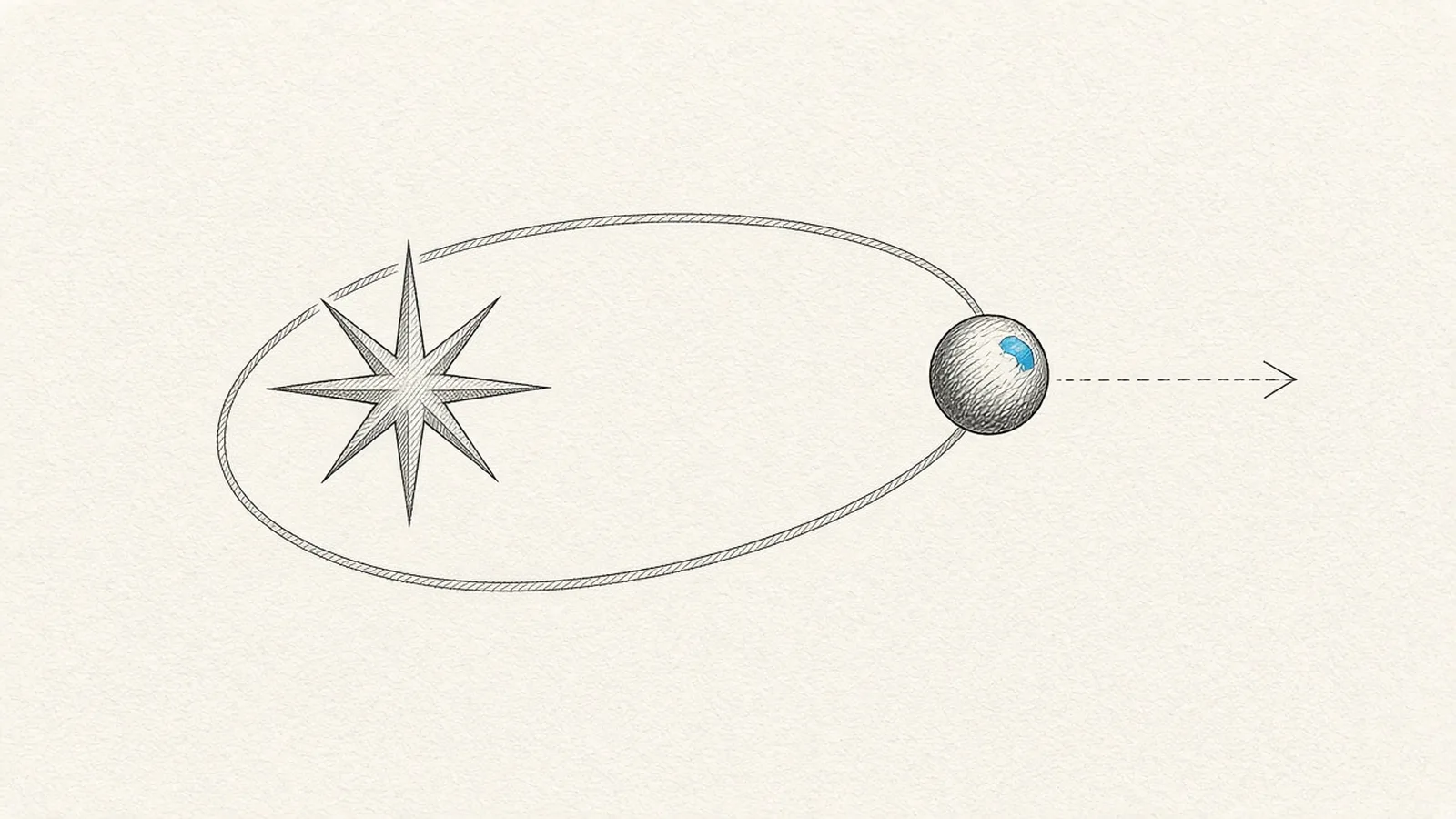
An orbit is a fall that never arrives. Whoever has read it knows it, whoever has seen it happen understands it: a body thrown sideways falls toward the star, but its speed carries it elsewhere, and so it falls again, and again, without ever touching.
You do not need the sky to see it. A plane is enough. In two dimensions gravity stays Newton's: every body pulls every other body, and the force depends on the masses and the distance. Everything else is the hand that throws.
The plane as a table
In Gravity Sandbox, one of the Impossible Lab experiments, you create stars and planets, give them a velocity and watch what happens: orbits, encounters, mergers. It is a small universe that fits on a table, and it does not ask to be believed. It asks to be tried.
The method is simple. Place a large mass at the centre. Place a small mass at a distance and let it go from rest: it falls straight into the star. Repeat with a sideways push: the fall bends. With a stronger push the curve opens, and the body never returns. In between, for a narrow range of speeds, the body circles.
No formula explains this better than the wrong attempt. Whoever has watched a planet fall straight and then escape to infinity already knows where the orbit lies: in the narrow space between the two.
What it conserves, what it does not
The tool states its rules, and that is part of its honesty. Gravity is Newtonian, in two dimensions. Time advances in fixed steps, with an integrator called velocity-Verlet. At very short distance the force is softened, regularised, so that two almost overlapping bodies do not explode into an infinite force. The units are arbitrary.
Collisions merge masses. Momentum is conserved, kinetic energy is not: something is lost in the impact, and the model admits it. It is not an astronomical prediction, and nobody should use it as one.
This statement matters as much as the simulation. A model that names its limits teaches two things at once: how the simplified world moves, and that every simplification has a price. Whoever plays learns the orbit and, in passing, to distrust a model that does not say what it left out.
The object and the myth
There is an old habit: looking at the sky and seeing an order in it. Then someone drew the order on a sheet and the sky became a machine. A small machine, inside a screen, repeats that gesture today: the celestial sphere reduced to a plane, the plane reduced to a few rules.
What is worth remembering is not that the simulation is right. It is that it can be taken apart, its parts examined, and put back together. A civilization that still knows how to do this keeps its sky. One that stops keeps only its image.
> ln -s ./linked-nodes
- [RELATED] Gravity Sandbox