The Recent Implant Hypothesis
What if the past were an uploaded memory, not a sequence actually lived? A note on simulation theory and the distinction between lived and loaded: a habitable reality needs continuity, and history already functions as an interface.
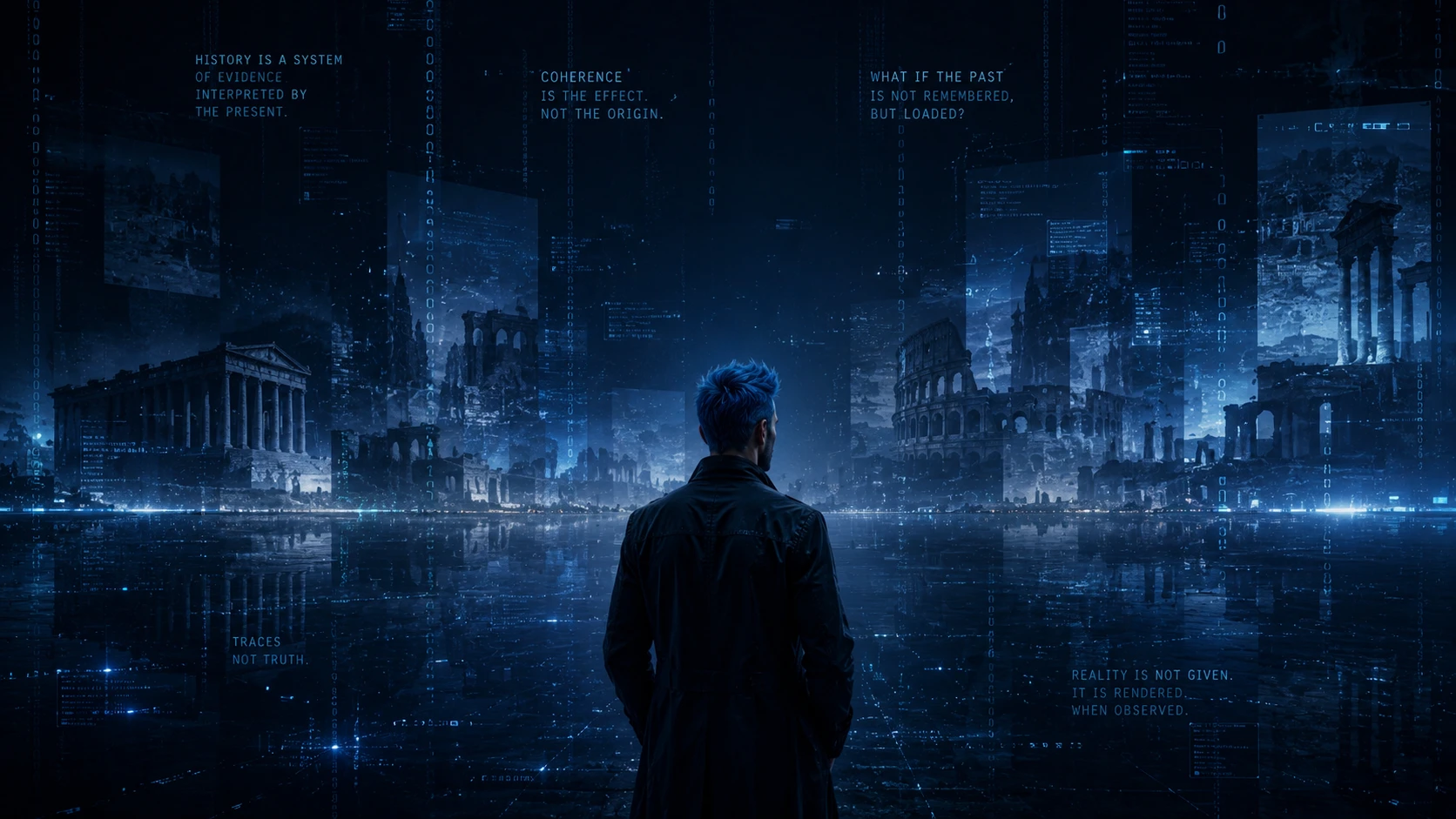
The most disturbing idea in simulation theory is not that the world might be false. It is that the world might be true only from a certain point onward.
We are used to thinking of reality as a continuous line: billions of years of universe, millions of years of evolution, millennia of civilizations, centuries of documents, generations of memories. But this continuity is, to a large extent, an act of trust. We do not directly inhabit the past: we inhabit traces of the past. Documents, ruins, books, stories, dates, genealogies, archives, fossils, calendars, traditions. Everything we call "history" is a system of evidence interpreted by the present.
The uncomfortable question is this: if reality were simulated, or if it had been built as an operating environment for an already adult consciousness, would it really need to have a real past? Or would a coherent past be enough?
Not true or false, but lived or loaded
This is the recent implant hypothesis: not necessarily the idea that humanity was physically brought to Earth two thousand years ago, but that our historical experience may have been "started" with an already precompiled memory. A world with continents, languages, ruins, institutions, sacred texts, fallen empires, founding myths, family trees and collective traumas already inserted into the system as initial data.
In an open-world video game, the player enters a city that appears to have centuries of history. There are statues, poor districts, noble families, ancient wars, forgotten documents, worn maps, objects with descriptions. And yet that world did not actually live through all those years. It was designed to look as if it had. Historical depth is an effect of coherence.
If we move this reasoning onto our reality, the point is not to prove that the past is false. The point is to recognize that the past is never given to us directly. It is always a reconstruction. Our certainty arises from the stability of traces, not from access to the original event.
Two thousand years of readable memory
From this perspective, the horizon of the last two thousand years becomes interesting not because "nothing existed" before, but because it coincides with an enormous densification of accessible cultural memory: religious texts, imperial chronologies, institutions, law, literacy, archives, cities, trade, genealogical narratives of power. It is as if, from a certain point onward, the system began producing a memory that was more readable, more synchronized, and more compatible with the modern idea of history.
Of course, the ordinary explanation is much simpler: the evolution of civilizations, writing, archives and preservation techniques made the past progressively more documentable. But simulation theory invites a sideways step: what if this progressive documentability were not only a historical effect, but also a narrative requirement of the system?
A habitable reality needs continuity
Personal identity needs memories. Communities need origins. Institutions need legitimacy. Money needs trust. Law needs precedents. Religion needs foundations. Science needs causal sequences. Without a past, the present would be psychologically unmanageable. But with a sufficiently coherent past, the present becomes stable.
The recent implant hypothesis therefore works on a subtle distinction: not between true and false, but between lived and loaded. A memory can orient a life even if it has been implanted. An archive can found a power even if it has been generated. A ruin can produce meaning even if its antiquity is part of the code. In a perfect simulation, what matters is not that every previous event actually occurred, but that every trace is compatible with the others.
History as an interface
This does not mean denying history. It means noticing that history already functions as an interface for us. None of us personally verifies ancient Rome, the Middle Ages, the first human migrations or the formation of the Earth. We rely on systems of knowledge, methods, institutions, experts and instruments. Shared reality is born from this organized trust.
And this is where the question becomes more interesting: if we lived in a simulation, the past would be the cheapest place to simulate. The present requires continuous calculation, interaction, contingency and choice. The past, instead, can exist as a queryable database. It is rendered only when we observe it, study it or discuss it. There is no need to simulate every instant of every ancient life; it is enough to produce coherent traces when someone looks for them.
We always wake up inside a reality that has already begun
In this sense, the idea of being "implanted" on Earth should not be read only as science fiction. It can be understood as a radical metaphor for the human condition: we always wake up inside a reality that has already begun. We are born into languages we did not choose, into collective memories that precede us, with moral, economic and symbolic maps already operating. Consciousness always arrives afterward.
Perhaps the point is not whether we have been here for two thousand years, two million years or five minutes. The point is that reality, in order to function, must convince us that it has roots. And we call "real" whatever manages to produce enough continuity to keep us from falling into the void.
The recent implant hypothesis therefore does not ask us to blindly believe an alternative theory of history. It asks for something subtler: to observe how much of our certainty depends on memories, archives, conventions and systems of trust. After all, if a simulation wanted to be credible, it would not only have to invent the world. It would also have to invent its past.
And perhaps it is precisely there, in the past, that a simulation would best hide its code.
> ln -s ./linked-nodes
- [PART OF] Simulation & Reality