The Stick of Alexandria: How Eratosthenes Measured the Earth
Around 240 BC Eratosthenes measured the Earth's circumference with the shadow of a stick, a well in Syene and men who counted their steps.
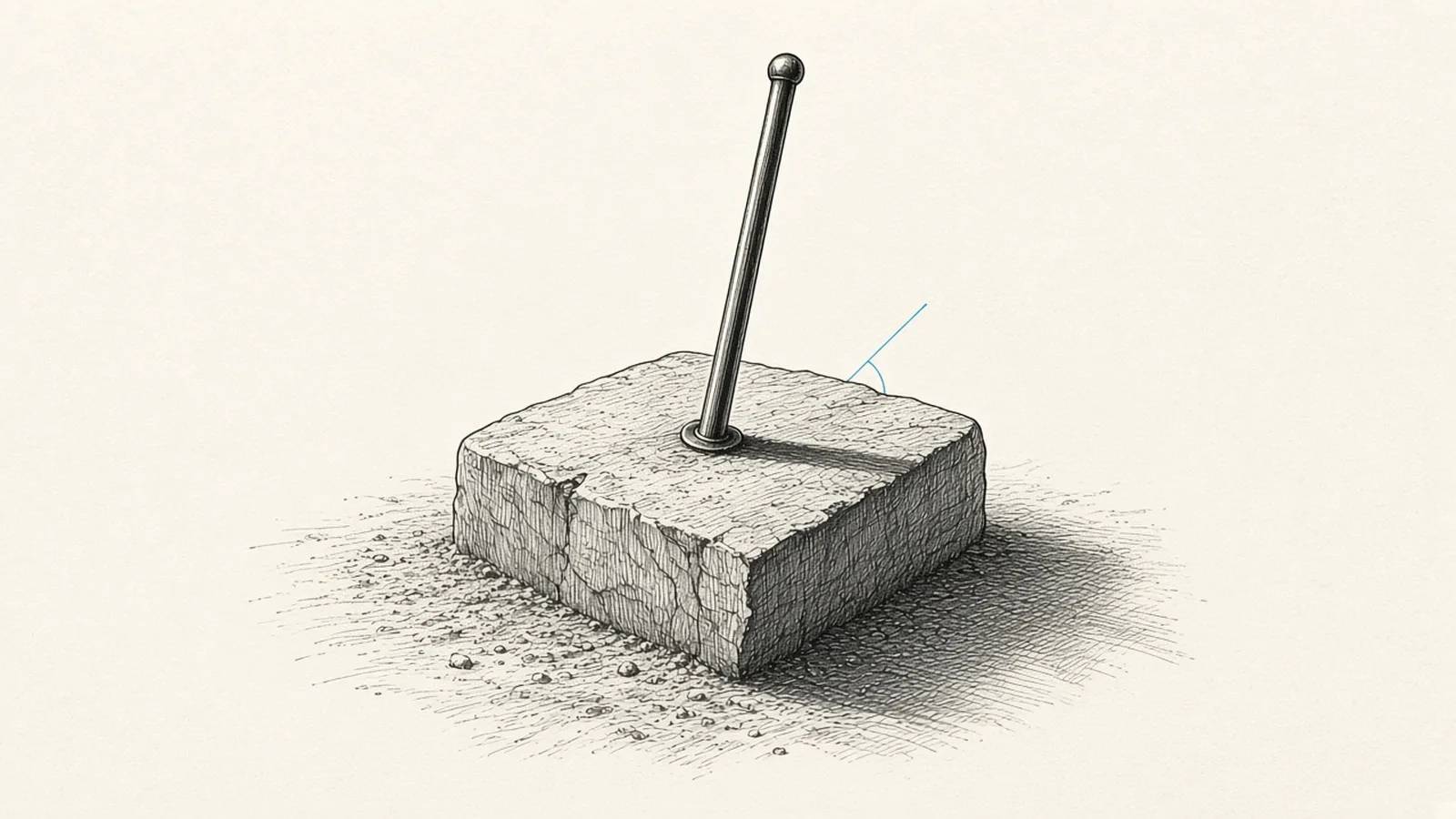
Around 240 BC, in Alexandria in Egypt, a stick planted in the ground measured a planet. It belonged to Eratosthenes of Cyrene, born around 276 BC in what is now Shahhat, Libya, and appointed by Ptolemy III to run the Library of Alexandria. His contemporaries nicknamed him "Beta": very good at everything, astronomy, mathematics, geography, philosophy and poetry, but never first in any of them. The manuscript in which he described the measurement is lost. We know his method only because other writers told it.
Eratosthenes wanted to draw a map of the whole world, and for that he needed the size of the Earth. That it was round was by then common opinion among educated Greeks. How big it was, nobody knew, and walking around it was not an option.
A well without a shadow
Travellers had told him about a well in Syene, today's Aswan. At noon on the summer solstice the Sun lit its entire bottom, with no shadow: it stood exactly overhead. On the same day, at the same hour, an upright stick in Alexandria did cast a shadow. Eratosthenes measured its angle: about 7.2 degrees, roughly one fiftieth of a full circle.
That is the whole argument. If the Sun's rays arrive parallel, the difference in slant between the two cities is the slice of the Earth's curve that separates them. All you need is the distance from Alexandria to Syene, multiplied by fifty. The hard part was exactly that distance. Camel caravans, often used to estimate journeys, wandered and changed pace. So Eratosthenes turned to bematists, surveyors trained to walk with steps of equal length. They counted about five thousand stadia. The Earth, then, measured about two hundred and fifty thousand.
The error that sent Columbus sailing
How long Eratosthenes' stadium was, scholars do not know for sure. Depending on the estimate, his circumference falls between about 38,600 and 46,700 kilometres. The real figure at the equator is about 40,000. His premises were not perfect: Alexandria is not exactly due north of Syene, and Syene is not exactly on the tropic. But the method was right, so much so that students still repeat it today with a stick and a shadow.
A few decades later Posidonius redid the measurement using the star Canopus and the stretch between Rhodes and Alexandria. But he started from a wrong distance and got an Earth more than a quarter too small. Ptolemy, in the second century AD, chose that value for his Geography, and centuries later Christopher Columbus believed it: a small Earth could be sailed around. With Eratosthenes' number, perhaps, he would never have set out.
What strikes me is the mismatch between the tool and the thing measured. A stick, a well, men counting their own steps, and on the other side an entire planet. It is the point the essay Thinking Against Cosmic Scale takes seriously: vastness does not make small work useless, it forces it to be precise. The stick in Alexandria knew nothing about the Earth. It only knew how to stand straight, and its shadow, that noon, was long enough to reach Syene.
Source: This Month in Physics History: Eratosthenes Measures Earth, Alan Chodos, APS News, June 2006 (accessed 23 October 2026).
> ln -s ./linked-nodes
- [PART OF] Cosmic Scale
- [RELATED] Thinking Against Cosmic Scale
- [REFERENCED BY] Henrietta Leavitt's Rhythm: the Stars That Measure Distance