The Cloud on the Seabed: the Orkney Cylinder and Its 864 Servers
In 2018 Microsoft lowered a sealed cylinder holding 864 servers to the seabed off Orkney. For two years the cloud was a building underwater.
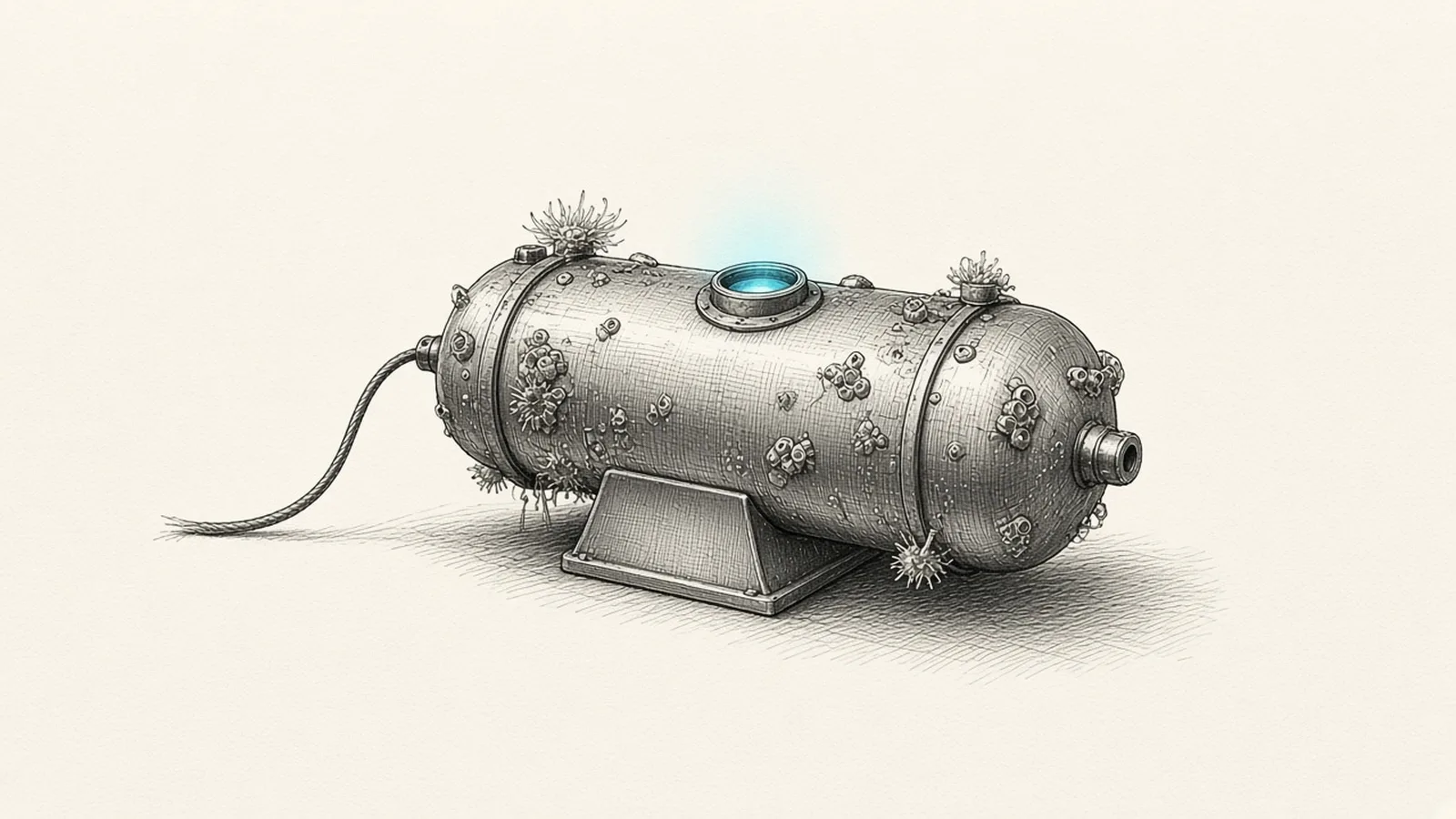
In spring 2018, off the Orkney Islands in Scotland, a barge lowered a white steel cylinder the size of a shipping container to the seabed. It was called Northern Isles. Inside were twelve racks holding 864 servers and their cooling system. Before closing it, Microsoft's engineers had filled it with dry nitrogen and sealed it. Then they left it 117 feet down, about thirty-six metres, at the European Marine Energy Centre, a test site for tidal turbines and wave energy converters.
It was the second phase of Project Natick. The idea had surfaced in 2014 during ThinkWeek, the internal event where employees share out-of-the-box proposals; in 2015 a first prototype had spent 105 days in the Pacific, off California. The Orkney cylinder was built by Naval Group, a French company that knows submarines. A cable connected it to the islands' power grid, supplied entirely by wind, sun and the marine centre's experimental technologies. In 2020, during the pandemic, its servers also worked for Folding@home on vaccine-related research.
The cloud that has an address
We say "cloud" as if our files rose somewhere, weightless, above the cities. The word works because it hides. A cloud has no walls, no doors, it does not break down. The Orkney cylinder turned the image over with an almost accidental precision: the cloud was not up high, it was at the bottom of the sea, bolted to a ballast-filled triangular base, with a cable and a fibre keeping it tied to land.
In July 2020 the Natick team brought it back up. It took a full day, in unusually calm seas, with robots and winches working between the pontoons of a barge. The cylinder, which had gone down white, was coated with a film of algae and barnacles; in the sheltered nooks of the base, sea anemones had grown to the size of melons. Before opening it, the engineers inserted test tubes through a valve at the top to sample the air inside and send it for analysis in Redmond.
What breaks less
The result was the project's most quoted figure: the servers under the sea had failed at one-eighth the rate of those in an identical replica kept on land. The researchers suggested two causes. Nitrogen, less corrosive than oxygen. And the absence of people bumping, moving and replacing things. A closed machine, kept cold and left without visitors, lasted longer.
Here myth touches the object, and goes no further. A sealed container, lowered to the bottom, left untouched by hands for two years and then reopened with care, its air sampled before anything else is touched: that is the gesture of someone who deposits, not someone who installs. In the essay When Technology Becomes Myth I write that a technical object becomes a story when its function stops being visible. The cloud is already that story. Natick turned it back into an object, with a weight, an address and a crust of sea on top.
In 2024 Microsoft confirmed that the project was no longer active and that it had no servers underwater. The cylinder went back to being what it had always been: a building, small and watertight, that for two years held a piece of the cloud on the seabed.
Sources: John Roach, "Microsoft finds underwater datacenters are reliable, practical and use energy sustainably", Microsoft, 14 September 2020; Wikipedia, Project Natick (accessed 4 November 2026), citing among others Data Center Dynamics, 17 June 2024.
> ln -s ./linked-nodes
- [PART OF] Technological Mythology
- [RELATED] When Technology Becomes Myth