The System That Dreams: when reality begins writing probabilities
A bridge article for The System That Dreams: destiny, matrix, choice and collective consciousness as architectures that shape the field of possibility.
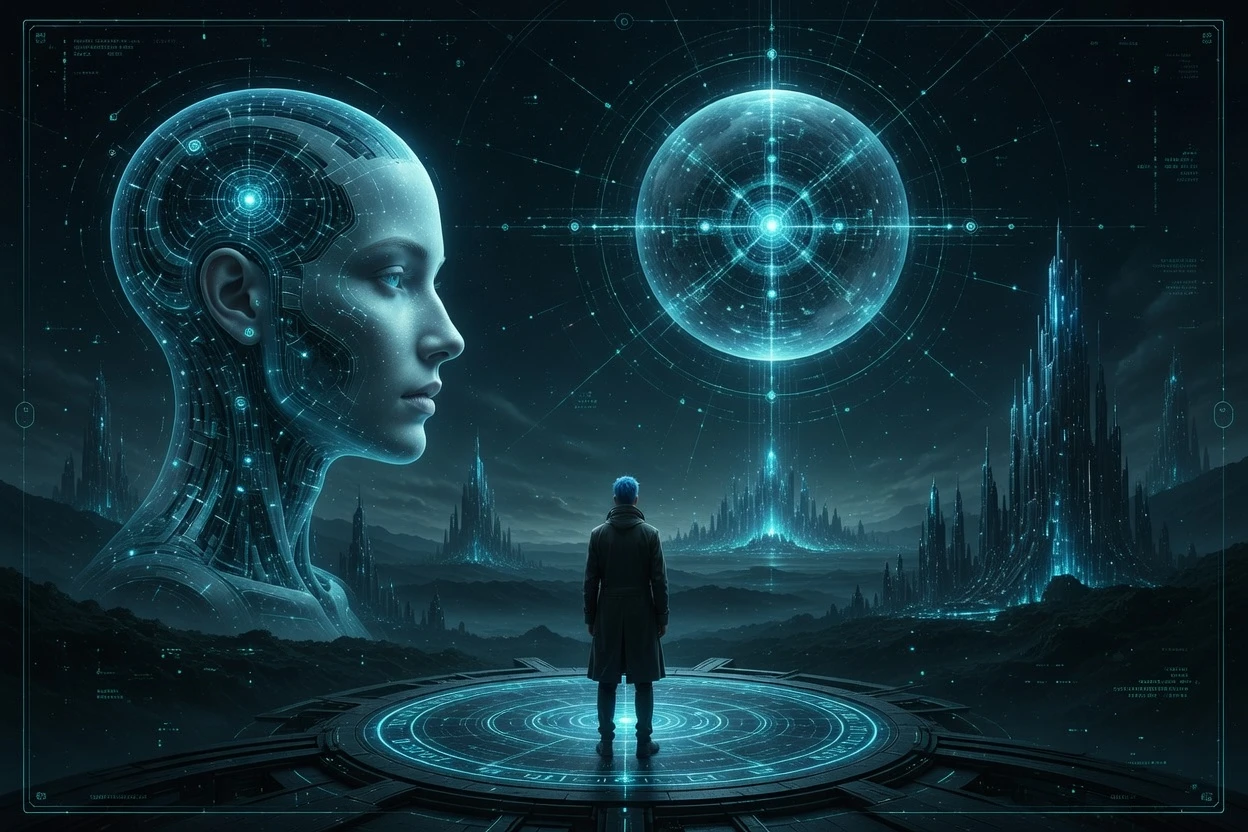
signal --book=the-system-that-dreams --axis=probability
The System That Dreams begins with a question less simple than it appears: what if destiny is not a sentence already written, but an environment that keeps modifying the probabilities of our choices?
The point is not to imagine a total prison. A powerful system does not need to erase freedom. It only has to build frames, urgencies, fears, rewards, languages and paths narrow enough to make one direction feel natural. The choice remains ours, but the field in which we choose is never neutral.
We do not live inside a destiny already written. We live inside a system that continually writes the probabilities of our choices.
The matrix as environment
The word matrix becomes poor when it is reduced to illusion. Here it is more useful as an operating environment: a set of visible and invisible rules deciding which possibilities become thinkable, desirable, convenient or even sayable.
A human being inside a system does not simply see the world. They see the world through preloaded categories: success, failure, guilt, performance, belonging, normality, deviation. Each category acts as a filter. It does not prevent all vision, but it makes some things salient and others almost invisible.
Probabilistic destiny
This is why destiny in the book is not fatalism. It is organized probability. Some choices become easy because the system rewards them. Others become hard because they lack language, time, support or recognition. A person can be free in theory and trapped in practice inside a field of invisible costs.
The most disturbing part is that many systems do not present themselves as control. They present themselves as comfort, efficiency, protection and identity. They suggest what to desire before you understand that you are desiring. They orient you with a softness that resembles your own inner voice.
The glitch
The glitch is the moment when the frame cracks. It is not always revolution. Sometimes it is a sentence that no longer fits, a choice suddenly becoming visible, a feeling of estrangement before something that once seemed obvious. The glitch does not destroy the system: it reveals that the system exists.
In this sense The System That Dreams is not only about external control. It is about the fragile zone where system becomes perception and perception becomes destiny. Exiting does not mean escaping the world. It means distinguishing reality from the grammar we were taught to use when reading it.
The book connects to Reboot because every civilization that forgets its machines also risks forgetting the systems those machines installed inside thought. But it opens a different layer: not only what remains after collapse, but what governs us while we believe we are choosing.
[ RUN :: OPEN THE SYSTEM THAT DREAMS ]
> ln -s ./linked-nodes
- [REFERENCES] The System That Dreams · Book
- [PART OF] The Machine, the System, the Eras, the Frequency, the AI
- [PART OF] Simulation & Reality
- [REFERENCED BY] The System That Dreams · Book
- [REFERENCED BY] The Machine, the System, the Eras, the Frequency, the AI