The Drawer That Answers: Luhmann and His Ninety Thousand Slips
For more than forty years Niklas Luhmann filled a card index of about ninety thousand slips, numbered with no topical order. It became a wooden colleague.
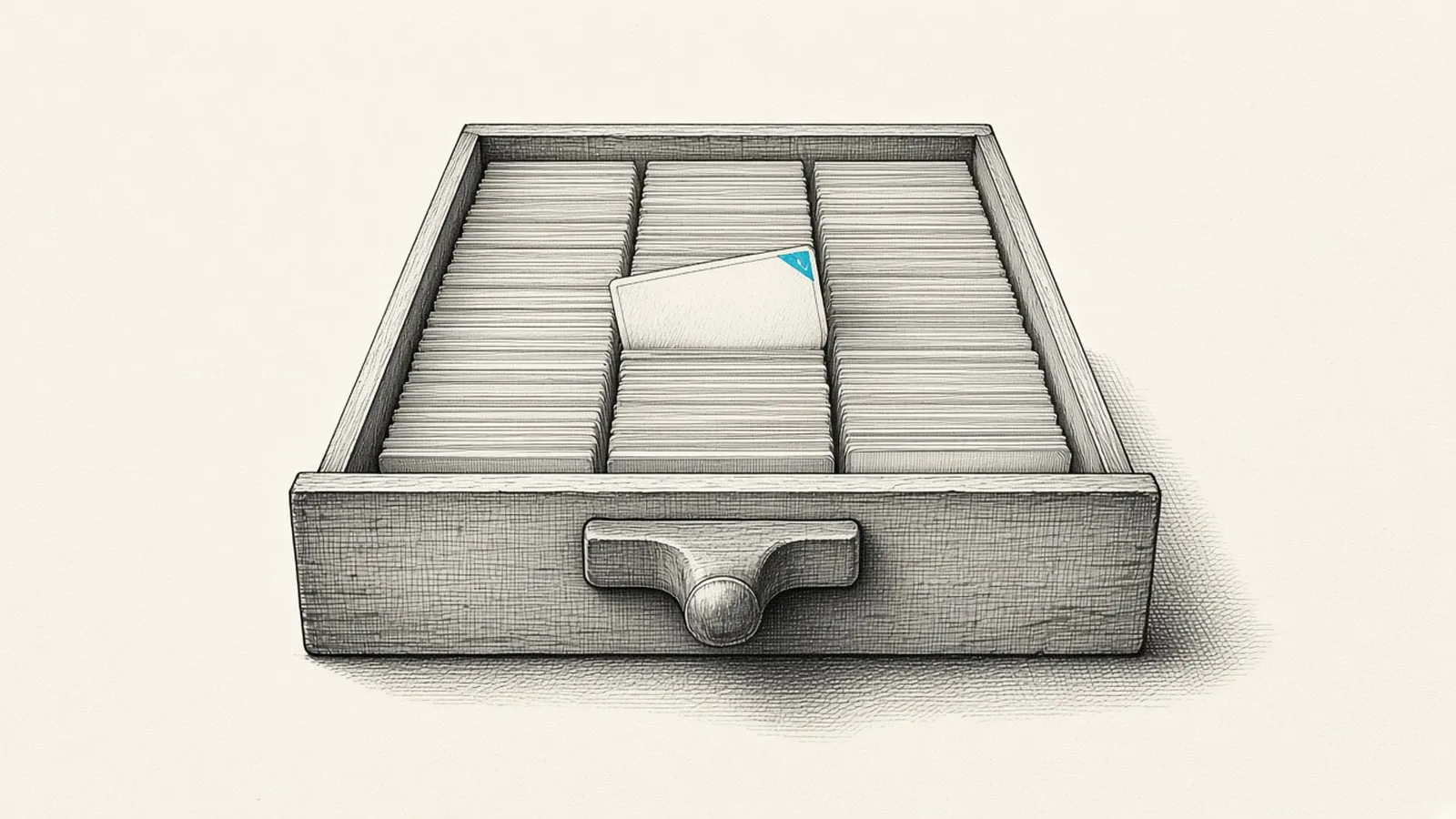
When he was asked about his research plan, the German sociologist Niklas Luhmann, newly appointed professor at the new University of Bielefeld, answered in three lines: "The theory of modern society. Duration: 30 years. Costs: none." It was not entirely true. There was a cost, and it sat in a piece of wooden furniture: a cabinet of drawers full of slips of paper, which Luhmann had begun filling in the early 1950s and would keep feeding almost until his death in 1998.
In the end there were about ninety thousand slips. Luhmann wrote dozens of books and hundreds of articles, on law, economics, art and love, and credited that card index, the Zettelkasten, with making it possible. In 2019 his university digitised the drawers and put them online.
An address that says nothing
The detail that matters is the driest one. Luhmann refused to order his slips by topic. A topical order, he explained in the essay Kommunikation mit Zettelkästen, published in the early 1980s, is like the outline of a book: a decision taken today that binds you for decades. If your thinking grows in an unexpected direction, there is no longer any place to put it.
He chose a fixed place instead. Each slip got a number that had nothing to do with its content, such as 57/12. The next thought became 57/13; a detour born from one particular word on that slip became 57/12a, and then 57/12a1. On the slip itself, in red, he marked the point where the branch began. The box could thus grow inwards, slipping a new idea between two old ones, without ever moving anything.
The fixed number made the rest possible too: references from one slip to another, as many as he liked, and a keyword register that pointed to only a few entry points. Where a new note goes becomes almost irrelevant, Luhmann wrote, as long as the link is recorded. It is the same logic as a well-made web address, which I wrote about in the post on the slug: a name that does not change lets everything else change.
The partner who surprises
Then comes the part that sounds like an exaggeration. Luhmann describes the card index as a communication partner, almost a colleague. And the condition of all communication, he says, is that the partners can surprise each other. After a few years of cross-references, opening a drawer to look for one thing, he would find another he had forgotten he knew, tied to it by a thread he did not remember stringing.
It is the opposite of the rubber duck, which works precisely because it does not answer. The card index answers, but only with what it has been given, and only if it was given in the right form: one thought per slip, written out in full, with its address and its links. No magic: a daily discipline that years later gives back more than it received.
For anyone who writes and builds today, the lesson is not about slips of paper, nor about the software that imitates them. It is about the moment when order is decided. Whoever sorts everything at once, into categories, builds an archive that can only confirm what they already thought. Whoever gives each idea a stable place and links it by hand builds something that can still contradict them. It is the same idea behind The Builder's Operating System: structure does not think for you, it keeps open the chance of being surprised.
A wooden drawer is, in the end, a modest object. But Luhmann's had a rare property: it remembered things in an order its owner had not foreseen.
Sources: Niklas Luhmann, "Kommunikation mit Zettelkästen. Ein Erfahrungsbericht", in Universität als Milieu, Haux, Bielefeld 1992 (English translation); Niklas Luhmann and Zettelkasten, Wikipedia (accessed 22 November 2026).
> ln -s ./linked-nodes
- [PART OF] Builder Operating System
- [RELATED] The Builder Operating System
- [RELATED] The Slug: a Line of Lead Inside Every Address