The Box of Pins: the Galton Board and the Order Born of Chance
In 1874 Francis Galton showed a box of pins and balls: every fall is unpredictable, yet the sum always draws the same bell.
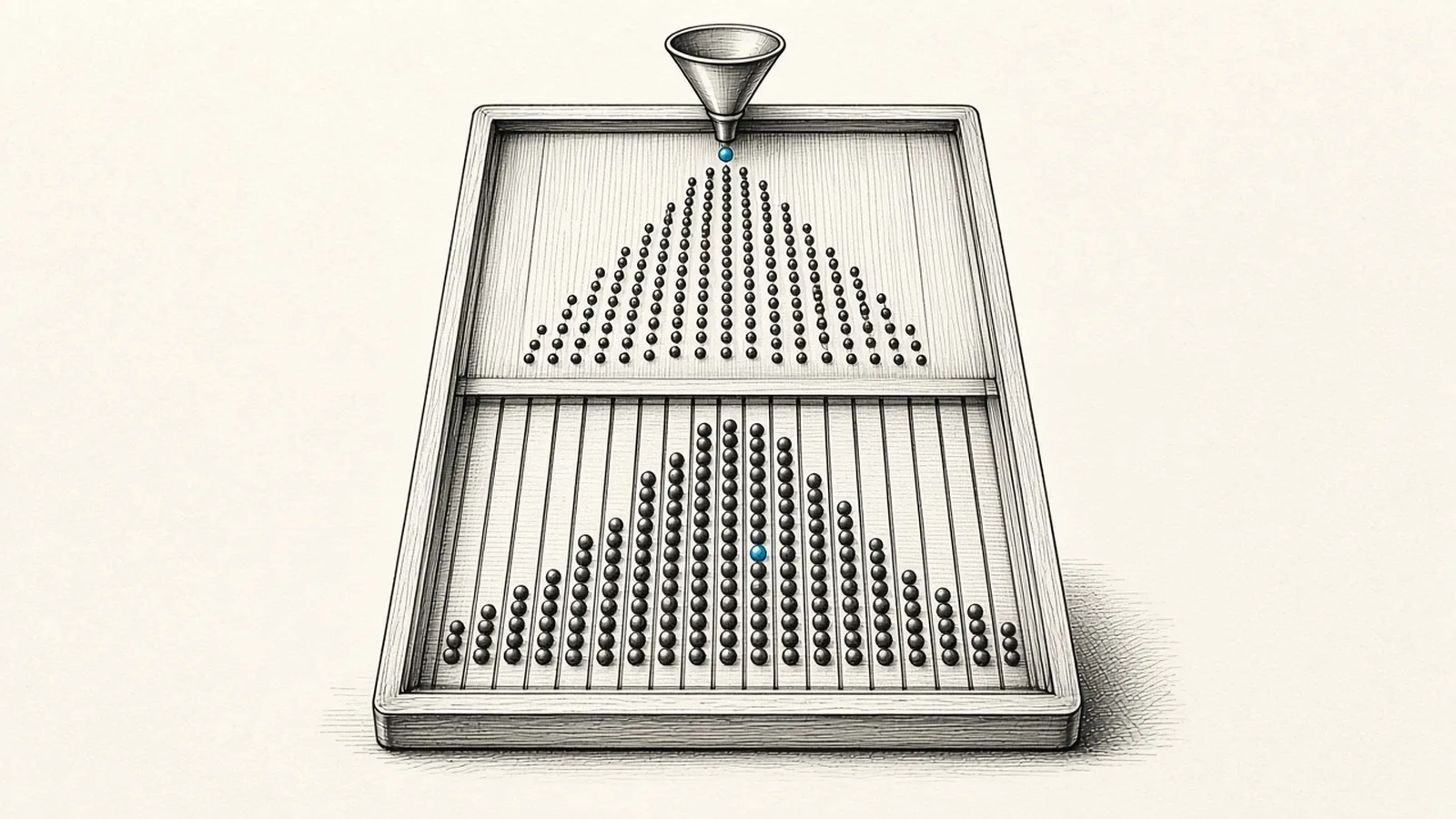
On the evening of 27 February 1874, at the Royal Institution in London, Francis Galton brought before his audience an upright box. Inside were staggered rows of pins, one above the other, and at the bottom a series of narrow compartments. At the top, a funnel. Galton called it the quincunx, after the five-point arrangement of the pins, like the five on a die. Today it is known as the Galton board.
The way it works is almost trivial. A ball falls, hits the first pin and bounces left or right. Then it hits the next pin and again picks a side. Nobody can say where it will end up. But when there are hundreds of balls, the compartments always fill the same way: few at the edges, many in the middle, a softly rounded hill. It is the bell curve, the normal distribution.
A simulation made of pins
The box measures nothing in the world. It simulates. Each pin is a coin toss, each ball a sequence of tosses, each compartment the number of times "right" came up. The number of paths leading to each compartment is given by Pascal's triangle, and with many rows and many balls the binomial distribution approaches the normal curve: the de Moivre–Laplace theorem, made visible without writing a single equation. Tilt the box, or change the shape of the pins, and the hill shifts or warps. The model answers to its rules, not to the wishes of whoever is watching.
Galton was enchanted by it. In 1889, in Natural Inheritance, he wrote that the "Law of Frequency of Error" reigns "with serenity" amid the wildest confusion, and that the Greeks would have deified it had they known of it. The huger the mob, he added, the more perfect its sway.
What the machine does not say
Yet Galton used the same box for another thesis. He wanted to show "reversion to mediocrity" and support eugenic ideas, namely that extreme human qualities were hereditary and should be managed. The machine contradicted him: it produced extreme values by pure chance, with no inheritance at all. Galton noticed and in 1875 tried to work around the problem; in an 1877 letter to George Darwin he described a two-stage version, with small trapdoors between the levels, which was never built.
Here the object becomes a small myth, in the most sober sense. A ball dropping between the pins knows nothing of the bell it is helping to draw. Order appears only in the sum, and whoever looks at the sum is tempted to read a destiny into it. The box shows a real regularity; it does not license anyone to say which compartment someone ought to belong to. The border between the shape of a distribution and a judgement about a person is not in the box, but in whoever interprets it.
It is the same question that runs through the essay Reality Through Interfaces: a model translates the world into a readable form, and the form can be mistaken for the world. It also echoes The System That Dreams, where destiny is read as organised probability rather than a sentence already written. For the other side of the coin, the site's chaotic triple pendulum shows a deterministic system becoming unpredictable; the Galton board shows unpredictable events which, added up, become predictable.
Sources: Galton board, Wikipedia (accessed 11 November 2026); Francis Galton, Natural Inheritance, Macmillan, 1889; Joachim Kunert, Astrid Montag, Sigrid Pöhlmann, "The quincunx: history and mathematics", Statistical Papers 42 (2001), pp. 143–169.
> ln -s ./linked-nodes
- [PART OF] Simulation & Reality
- [RELATED] Reality Through Interfaces
- [RELATED] Chaotic Triple Pendulum