The Mark II Moth: the Logbook That Corrected Memory
In 1947 at Harvard a moth found in a Mark II relay was taped into the logbook. A line written at the moment is worth more than a memory.
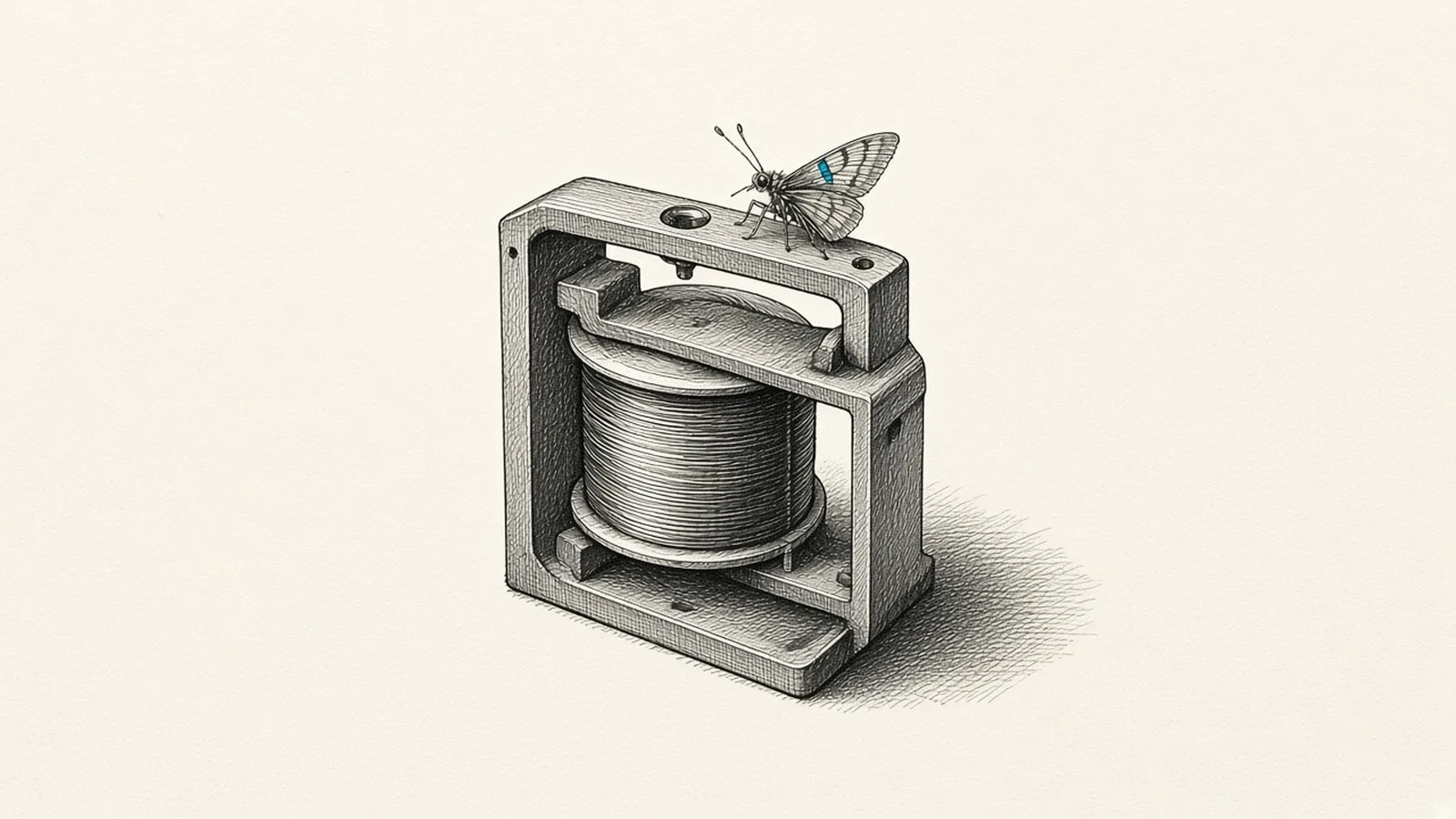
On 9 September 1947, at Harvard, the technicians working on the Mark II, a relay calculator, found a moth stuck in one of the machine's relays. They removed it, fixed it with a piece of tape to the page of the logbook and wrote one line beside it: "first actual case of bug being found". That page, with the moth still attached, is now kept at the Smithsonian Institution's National Museum of American History in Washington.
The joke works because the word already existed. American engineers had called small flaws in machines "bugs" at least since the 1870s: Thomas Edison used it about electrical circuits. The IBM engineers who installed the Mark I at Harvard in 1944 had taught the expression to the staff. The moth did not invent the term. It made it literal for an afternoon, and someone had the presence of mind to write it down.
A page that corrects memory
The Mark II team included the mathematician Grace Hopper, who later became a rear admiral in the US Navy and who used the word "bug" with particular enthusiasm. The museum notes that the logbook was probably not hers, but that she and the rest of the team helped spread "bug" and "debug". In 1981 Hopper published a short account of the episode, and there she placed it in the summer of 1945. The logbook page says something else: September 1947. Memory, more than thirty years on, had moved the date. The logbook had not.
The logbook itself nearly got lost, too. According to the US Navy it was found in 1988, with the moth still fixed beside the entry, in the computer museum of the Naval Surface Warfare Center at Dahlgren, Virginia. An ordinary working page, written for whoever came on the next shift, became an artefact.
The log as a builder's tool
I care less about the story of the word than about the gesture. Someone stops the machine, finds the cause, and before starting again writes down what happened, at the moment, where the others will read it. It is not an official report and it is not a memory: it is a trace taken while the event is happening, with the object itself taped on as evidence.
In 1949 Maurice Wilkes, in Cambridge, was trying to get his first non-trivial program working on the EDSAC. He later recalled realising, on the stairs between the machine room and the punching equipment, that a good part of the rest of his life was going to be spent finding errors in his own programs. Anyone who builds learns this early. The error comes back, changes shape, and the memory of how it was fixed is the first thing to go.
That is why, in the builder operating system, the log sits next to the rubber duck and the checklist: a small, almost ridiculous check that only counts if it is done right away. A dated line written today corrects the story we will tell thirty years from now. The Harvard moth is there to remind us, wings spread under the tape.
Sources: Log Book With Computer Bug, National Museum of American History, Smithsonian Institution; Peggy Aldrich Kidwell, Stalking the Elusive Computer Bug, IEEE Annals of the History of Computing, vol. 20, no. 4, 1998; First Computer Bug, CHIPS, US Navy (accessed 26 October 2026).
> ln -s ./linked-nodes
- [PART OF] Builder Operating System
- [RELATED] The Builder Operating System
- [RELATED] The Rubber Duck: Explaining Code to Someone Who Doesn't Answer
- [REFERENCED BY] Cliff Stoll's Seventy-Five Cents: the Printer That Listened to the Intruder