The Economy Made of Water: Bill Phillips's MONIAC
In 1949 Bill Phillips built a hydraulic machine at the LSE that simulated the British economy by running coloured water in place of money.
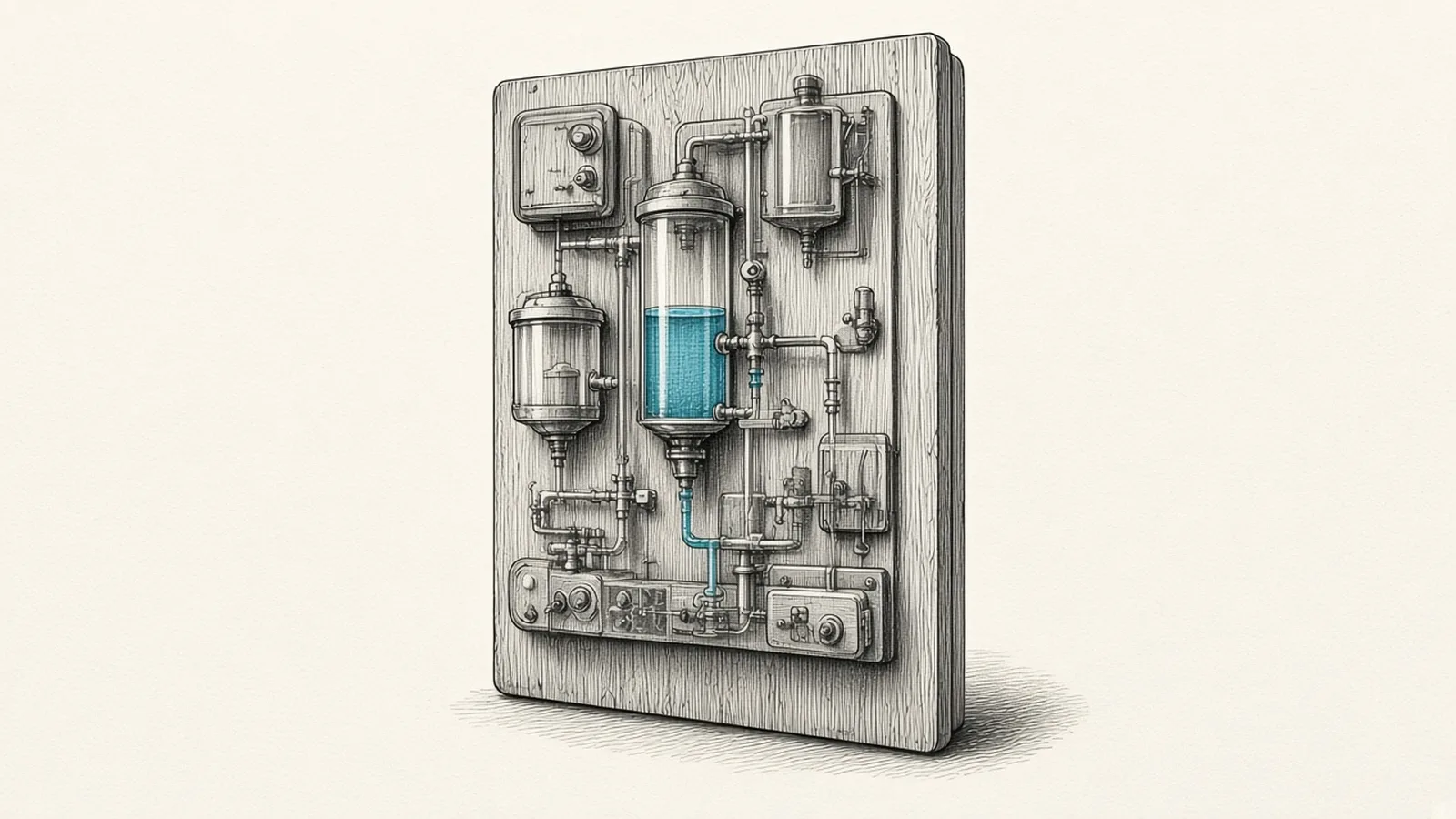
In 1949, at the London School of Economics, the British economy began to flow inside a machine two metres tall. It was made not of numbers but of coloured water, clear pipes, tanks, valves and pumps. It had been built by Bill Phillips, a New Zealander born in 1914 who had been an engineer before he became an economist. Having arrived at the LSE in 1946 after the war, he studied sociology and then economics, and found himself facing a practical problem: how to make the new equations being used to describe an entire nation understandable to people who were not mathematicians.
Money turned liquid
The answer was hydraulic. In Phillips's machine, water was money. Separate tanks stood for households, businesses, the government, exports and imports, and the liquid moving between them measured income, spending and national output. Opening or closing a valve changed, for example, the rate of interest on savings or investment. Some relationships, such as the way interest rates moved over time, were cut as curves into plastic sheets that the machine "read" as it ran. The prototype cost around four hundred pounds, and some of its parts came from a Lancaster bomber.
Phillips had thought of calling it the "financephalograph". Instead it took the name MONIAC, Monetary National Income Analogue Computer, reputedly to echo the ENIAC, the electronic computer built in the United States in the same years. But the MONIAC did not count digits: it let the level of the water find the balance. According to the Reserve Bank of New Zealand it could solve nine simultaneous equations whenever a parameter changed, and Phillips and his colleague Walter Newlyn found, to their surprise, that it could be calibrated to within about two per cent.
When the model leaks
About fourteen were built. They went to British universities and to institutions in Australia, New Zealand, South America and the United States. At the LSE a machine calibrated for Britain was often paired with a second one representing "the rest of the world", so that flows could pass from one to the other. The one used for teaching at the LSE ran until May 1992 and is now in the Science Museum in London. The first production machine, donated in 1987 to a New Zealand research institute and restored in 1991, is on display at the central bank's museum in Wellington, the only MONIAC known to work in the southern hemisphere.
The Science Museum, telling the story of the machine, adds a dry sentence: the models did not always match reality. To me this is the most honest part of the story. In a spreadsheet a wrong assumption stays invisible; in the MONIAC a leak shows, water spills from a tank, a badly set valve leaves a puddle on the floor. The model displayed its own limits as plainly as it displayed its flows. In the essay Reality Through Interfaces I write that every interface translates the world and reduces it at the same time. Phillips's machine is a translation that cannot hide what it is. Like Lorenz's three decimals, it is a reminder that a simulation is not the world but a vessel someone built, with joints that can give way. In front of those pipes you understand that even the most abstract economy is, in the end, something that flows, gathers and is lost.
Sources: Science Museum, How does the economy work?; Science Museum Group Collection, Phillip's Economic Computer; Reserve Bank of New Zealand, Introducing the MONIAC: an early and innovative economic model, Bulletin 70/4 (2007); Engineering New Zealand, MONIAC and Bill Phillips (accessed 31 October 2026).
> ln -s ./linked-nodes
- [PART OF] Simulation & Reality
- [RELATED] Reality Through Interfaces
- [RELATED] The Tube That Was Not Broken: Lorenz and the Three Decimals of 1961