Stopping Mid-Sentence: Hemingway, Kent Beck and the Broken Test
Hemingway stopped writing when he knew how to go on; Kent Beck ends a session with a failing test. Two rules about where to stop.
In 1958 the Paris Review published a long interview with Ernest Hemingway, conducted by George Plimpton. Halfway through, the interviewer asks whether he keeps to a strict schedule. Hemingway answers by describing a morning: when he is working on a book he writes every day as soon after first light as possible, when no one disturbs him and it is still cool. He reads what he has written and, since he always stops when he knows what is going to happen next, he goes on from there. He writes until he reaches a place where he still has his juice and knows what will happen next, and there he stops, and tries to live through until the next day, when he starts again.
It is not advice about inspiration. It is a rule about where to put the stopping point.
The chart on the cardboard
The same interview describes the tools with the precision of an inventory. Hemingway writes standing, at a bookcase, on a wooden reading-board at chest height, with five or six pencils beside him and a chunk of copper ore to weigh the papers down when the wind blows in. He always begins in pencil. He moves to the typewriter only when the work is going fast, or when it is simple, such as dialogue.
And he keeps count. He records each day's progress, "so as not to kid myself", on a large chart made from the side of a cardboard packing case, set against the wall. The daily word counts Plimpton sees vary: 450, 575, 462, 1250, 512. The high figures are days of extra work, so as not to feel guilty about spending the next day fishing on the Gulf Stream.
Stopping when you know how to go on, and measuring what you have done: two small, almost domestic habits. Together they form a system. The first lowers the cost of starting again; the second stops you from mistaking effort for result.
The test left broken
More than forty years later, the same gesture turns up in a programming book. In Test-Driven Development: By Example, Kent Beck collects a series of working patterns. One is called Broken Test. The question is: how do you leave a programming session when you are working alone? The answer: leave the last test broken. You write a test case, run it to be sure it does not pass, and stop. When you come back there is an obvious place to start, a concrete bookmark to remember what you were thinking.
Beck immediately adds the opposite case, Clean Check-in. When you work in a team, every test must pass at the end of a session. You do not know what has happened to the code in the meantime, and whoever picks it up must start from solid ground. The same rule, then, changes sign depending on who will find the work: the broken test is a note left to yourself, never to your teammates.
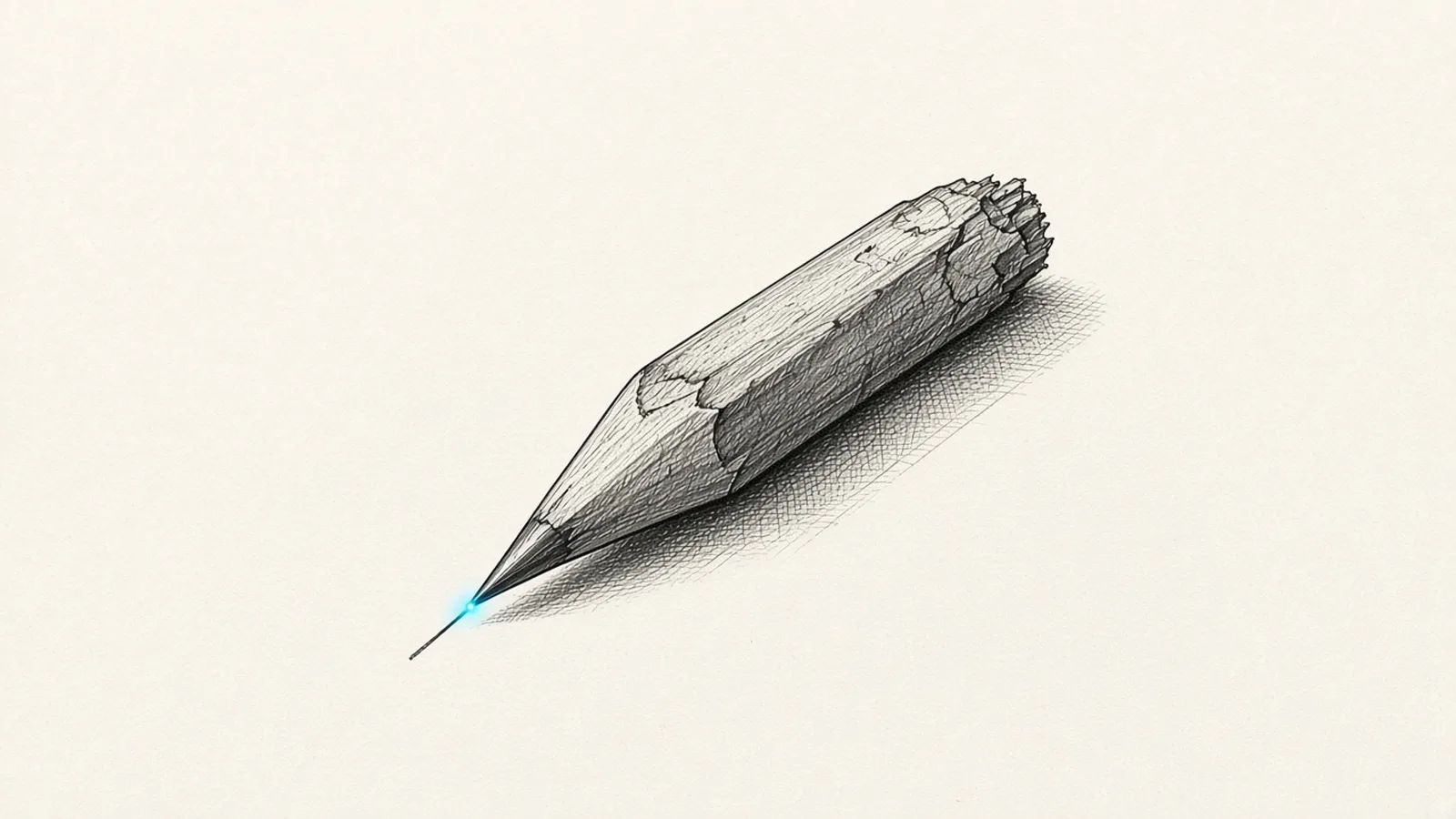
This is where the object becomes more than a habit. A pencil that stops mid-sentence is not laziness: it is a bridge thrown towards the next morning. The myth, if there is one, touches exactly this stub of graphite. Whoever builds, with words or with code, does not work against the blank page but against the moment they forgot where they were going. The rubber duck helps find the thread again by explaining it aloud; the tomato timer cuts it into measurable lengths. The broken test does something more modest: it leaves the thread outside the box, already cut at the right point.
In the builder's operating system these are the controls that last: not the ones that promise more output, but the ones that keep the count honest and the return to work easy.
Sources: George Plimpton, Ernest Hemingway, The Art of Fiction No. 21, The Paris Review (accessed 20 November 2026); K. Beck, Test-Driven Development: By Example, Addison-Wesley, 2002, patterns "Broken Test" and "Clean Check-in", as summarised in these reading notes.
> ln -s ./linked-nodes