The Slug: a Line of Lead Inside Every Address
The slug began as a line of lead cast by the Linotype. Today it is the name a page carries in its address: a promise the web breaks too often.
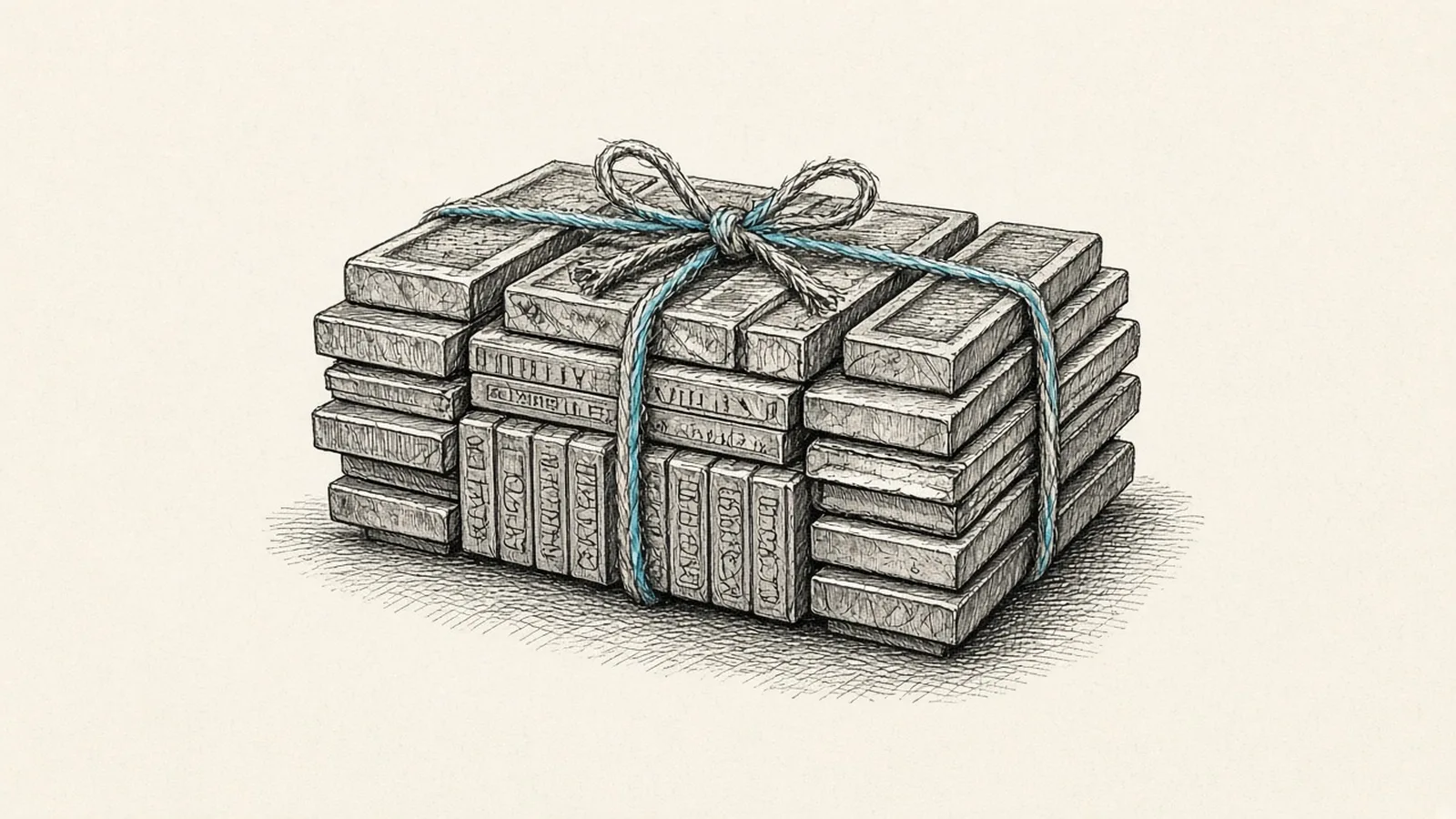
Every article on this blog has two names. One is the title, written for whoever reads it. The other is a row of lowercase words joined by hyphens at the end of the address: the slug. The title can change its tone, its punctuation, even its idea. The slug, if it is made well, never changes again.
The word comes from lead. In July 1886 the first Linotype went into service in the composing room of the New York Tribune. The operator typed a line on a ninety-key keyboard, the machine lined up the matrices and poured into them a molten alloy of lead, antimony and tin. Out came a single piece, a whole line of metal: the slug. Newsrooms later used the same word for the short internal name of an article in production, the one that follows it from the reporter all the way to the page. The web inherited it that way. The slug is the name a page carries in its own address.
A promise written into the address
In 1998 Tim Berners-Lee wrote a short page for the W3C titled Cool URIs don't change. The thesis is in the opening lines: URIs don't change, people change them. In theory, he observed, there is no reason to do it; in practice there are millions. The reorganized site, the moved files, the name of whoever maintained them ending up in the path. And whoever changes an address can never know who had bookmarked it, who had linked to it, who had scrawled it in the margin of a letter.
The price of those millions of reasons has been measured. In May 2024 the Pew Research Center published an analysis of nearly a million pages collected between 2013 and 2023: 38 percent of the pages that existed in 2013 were no longer accessible a decade later. More than half of the Wikipedia articles examined contained at least one reference pointing to a page that had disappeared. The web forgets quickly, and it almost always forgets through small decisions made by the people in charge of their own sites.
Casting the line only once
That is why choosing a slug is a gesture closer to the foundry than to writing. Berners-Lee advised leaving almost everything out of the address: the author's name, the document's status, the file extension, the software serving it. Everything that will change before the content does. Little remains: a few words saying what the page is about, lowercase, without accents, joined by hyphens.
On this site's tool bench there is SlugForge, a small utility that does exactly this: it takes a raw title and returns clean slugs, SEO titles, excerpts and meta descriptions. It is not a developer's indulgence. It is the point in the publishing flow where you decide what will stay fixed. The rest of the page can be rewritten, translated, corrected; the address is the part other people already hold.
It is the same discipline I describe in the essay on the builder operating system: content published without connections lives as a closed object, while content that enters a system becomes a node. But a node holds only if its name does not move. Every link that reaches this place from outside is a thread tied to one precise word.
When a Linotype operator made a mistake in a line, it was often quicker to cast it anyway and throw it away than to fix it inside the machine. With addresses we do not have that luxury. The line is cast once, and from that moment it also belongs to whoever reads it.
Sources: T. Berners-Lee, Cool URIs don't change, W3C, 1998 (w3.org/Provider/Style/URI); Pew Research Center, When Online Content Disappears, 17 May 2024; English Wikipedia entries "Linotype machine" and "Slug (publishing)", citing K. Massey, What's in a Slug?, The New York Times, November 2014.
> ln -s ./linked-nodes
- [PART OF] Builder Operating System
- [RELATED] SlugForge
- [RELATED] The Builder Operating System