The Tomato on the Desk: Twenty-Five Minutes That Do Not Divide
In the late 1980s a tomato-shaped kitchen timer became a method: an indivisible interval of work, wound by hand.
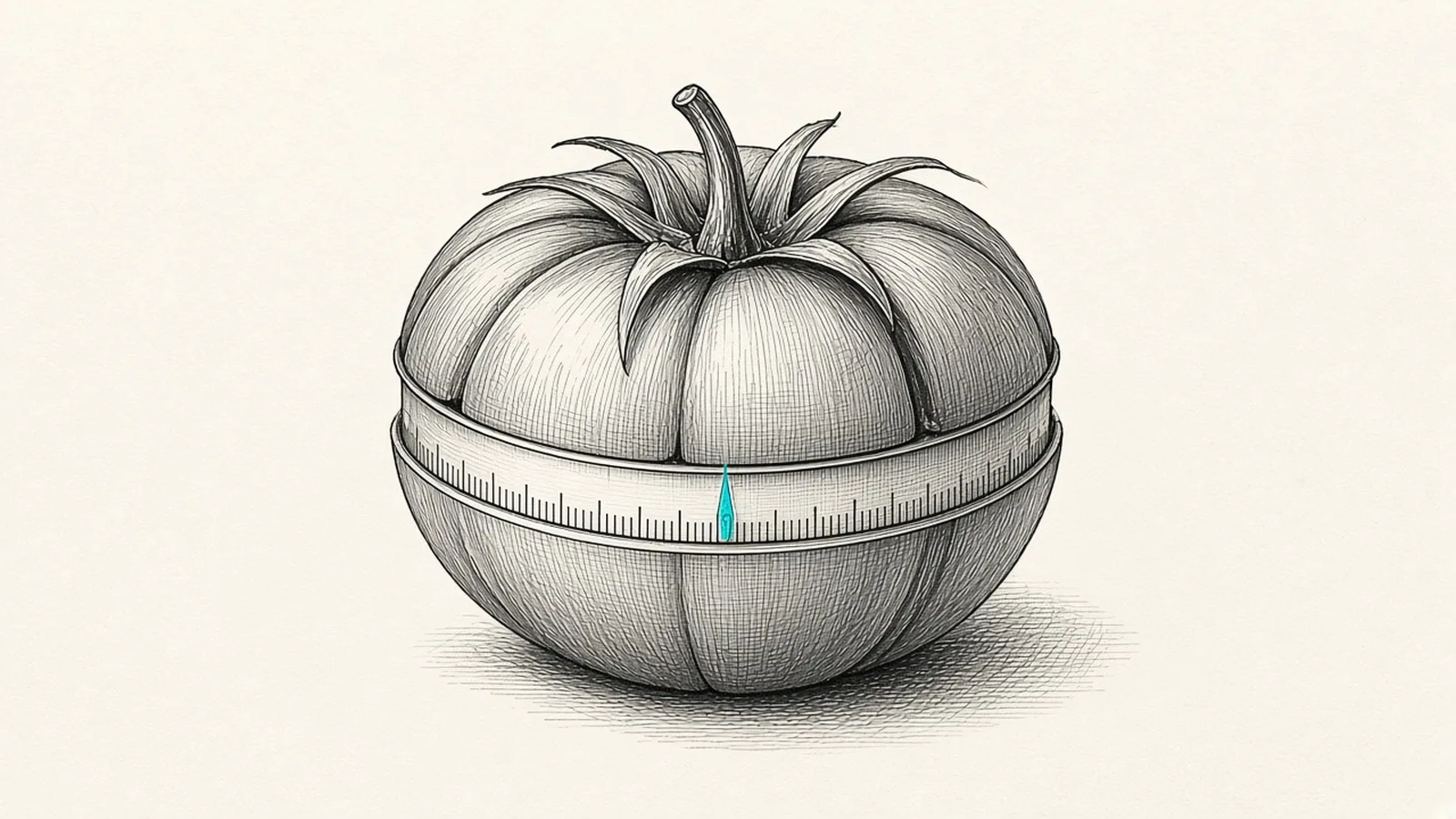
In the late 1980s a university student, Francesco Cirillo, was looking for a way to study without scattering himself. He found it in the kitchen: a mechanical timer shaped like a tomato, the kind you wind by turning its top half. He set it to a short interval, worked until it rang, then stopped. The method that grew out of it took its name from that object, the Pomodoro Technique, and so did its unit: a pomodoro, Italian for tomato, is an interval of work, usually twenty-five minutes.
The rule, in its original form, fits on a sheet of paper. You choose a task, wind the timer, work. When it rings, you put a mark on the paper and take a short break, five or ten minutes. After four pomodori comes a long break, twenty or thirty minutes, and the cycle starts again.
The interval that does not divide
The strictest point of the method is not the length. It is that a pomodoro is indivisible. If an interruption arrives during the interval, there are two roads: write it down and postpone it, or abandon the pomodoro and start over. There is no such thing as half a pomodoro. Anyone who writes code recognises the shape: it is an atomic unit, like a transaction that either goes through whole or never happened.
Meanwhile the list of postponed interruptions becomes a log. It says what tried to get in while you were working, and how often. At the end of the day the marks on the sheet do not measure talent: they measure how many whole intervals were actually defended. It is no accident that the technique sits close to timeboxing and iterative development, and has been adopted in pair programming too.
There is some data as well, more modest than the apps' promises. A study published in 2023 in the British Journal of Educational Psychology compared 25 students using pomodori with 35 who chose for themselves when to take a break. Those who regulated themselves worked in longer sessions and reported more fatigue, less concentration and less motivation. On task completion, though, there was no difference. The timer does not make you better: it makes you less tired of being good.
An object you wind by hand
The myth here touches a plastic vegetable on the desk. Cirillo and the method's proponents insist on a low-tech approach: a mechanical timer, paper, pencil. Winding it confirms the decision to begin; the ticking keeps the promise in the air; the ring announces the break, which is as much part of the work as the work. An app does the same things in silence, and for that very reason does them less.
For anyone who builds, writes and corrects, it is a check from the same family as the rubber duck: small, almost ridiculous, and precisely because it is an object it cannot be talked round. It belongs to what The Builder Operating System calls infrastructure: not willpower, but the tools that keep it standing when willpower runs out.
Whoever one day finds a tomato-shaped timer in a drawer may take it for a kitchen toy. It was a way of measuring the time of a distracted civilization instead: twenty-five minutes at a time, whole.
Sources: Tecnica del pomodoro and Pomodoro Technique, Wikipedia (accessed 18 November 2026), citing F. Cirillo, The Pomodoro Technique; F. Biwer, W. Wiradhany, M. G. A. oude Egbrink, A. B. H. de Bruin, Understanding effort regulation: Comparing 'Pomodoro' breaks and self-regulated breaks, British Journal of Educational Psychology 93 (S2), 2023, pp. 353-367.
> ln -s ./linked-nodes
- [PART OF] Builder Operating System
- [RELATED] The Builder Operating System
- [RELATED] The Rubber Duck: Explaining Code to Someone Who Doesn't Answer
- [REFERENCED BY] Stopping Mid-Sentence: Hemingway, Kent Beck and the Broken Test