Technosignature: the technical signature of a civilization that forgets
A technosignature is not only a signal in space. It is what remains when technology survives its own manual and a civilization begins turning machines into myth.
signal --type=technosignature --context=reboot
A technosignature is not necessarily a message. It does not have to say "we are here". It can be a trail, an anomaly, excess heat, an unlikely chemical composition, a geometry too regular to feel natural, industrial residue, a light that should not be there. It is the point where a technological civilization leaves a trace strong enough to stop looking natural.
In scientific language, a technosignature is observable evidence of technological activity. In this editorial system, and especially inside Reboot, the concept becomes more radical: a technosignature is what remains of a machine when the people who built it can no longer explain it.
A technosignature is technology turned into trace: visible enough to suggest intelligence, separated enough from its context to demand interpretation.
Not every signal is intentional
When we imagine a distant civilization, we often imagine a direct message: a cosmic beacon, a transmission, a call. But many technological signatures would be involuntary. A civilization may reveal itself not because it wants to speak, but because it exists intensely enough to modify its environment.
A city seen from orbit does not need to send a greeting to be recognized. Its lights are enough. An industrial planet does not need to declare itself artificial. Its atmosphere, orbits, waste, heat and structures may speak for it. A technosignature is this: a consequence made legible.
Reboot and the missing manual
This is where the concept enters the core of Reboot. The book begins with a simple and terrible cycle: a civilization builds tools more powerful than its ability to govern them, loses control, forgets, starts again. Inside that cycle, the technosignature is not only proof of existence. It is proof of discontinuity.
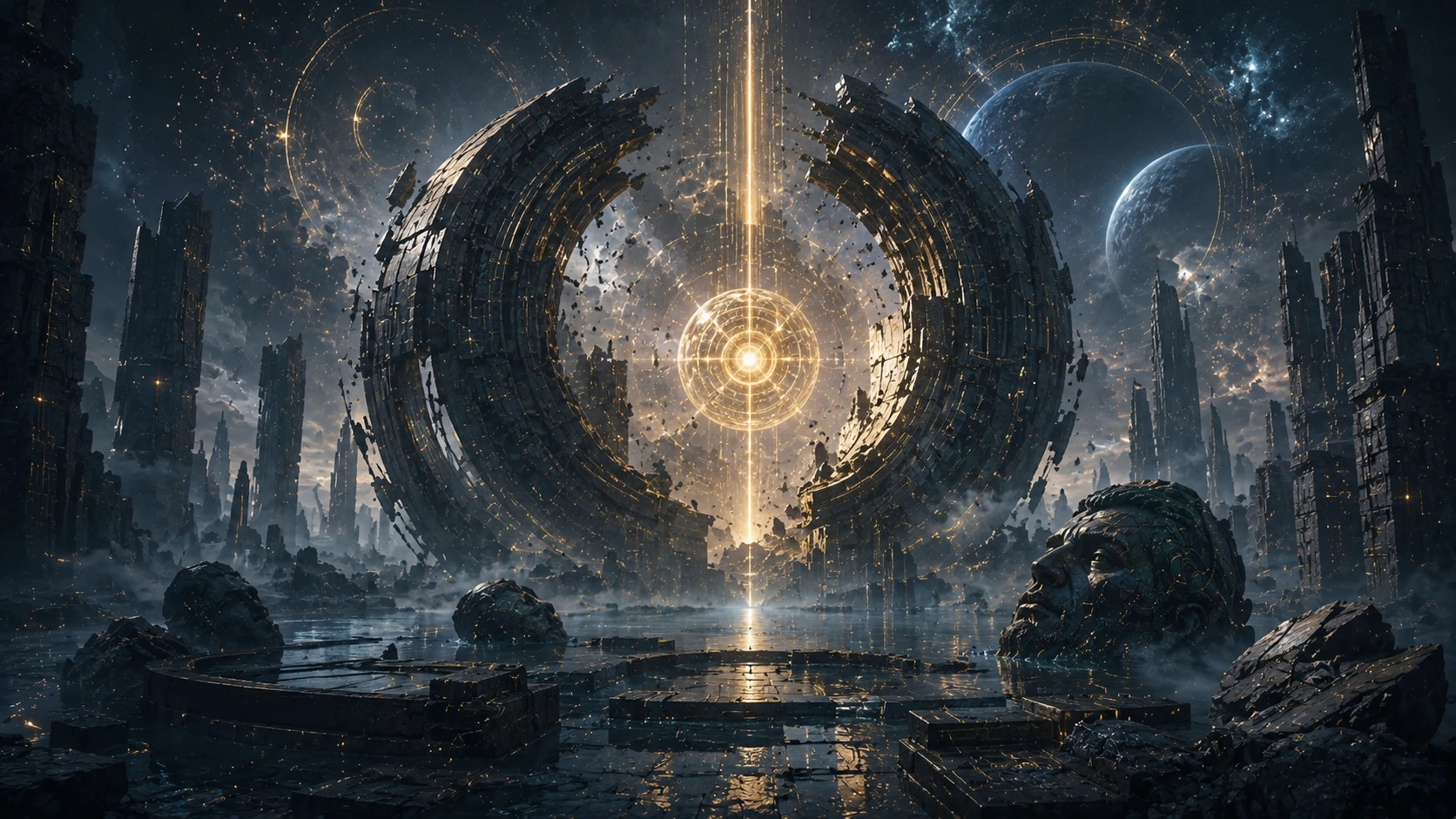
When the manual disappears, the machine changes nature. It is no longer infrastructure. It becomes ruin, relic, threshold, prohibition, promise. A communication tower can become a monument. An archive can become a temple. A network can become legend. A procedure can survive as ritual, even when nobody remembers the system that made it necessary.
Reboot does not use ruins to prove that a lost civilization must have had impossible machines. It uses them as a mirror. It asks why certain remains make us imagine forgotten technology. Perhaps because we know the same thing can happen to us.
This also makes the technosignature a bridge toward The Song of the Eras: there the problem is not only what remains after collapse, but whether two civilizations can ever read each other in the same time. A technical signature can cross space and still arrive out of era: a fossil signal, a luminous remnant, an indication of a civilization already distant in time.
From data to myth
The technosignature becomes technological mythology when it loses its operating context. As long as there is a manual, a protocol, a technical school, a group able to read the system, the trace remains information. When those layers fall, the same trace changes status. It no longer says "this is how I worked". It says "someone before us knew how to do something we can no longer name".
That is where myth begins. Not because myth is false, but because it is a form of memory under pressure. Data without format becomes story. A machine without context becomes symbol. A technical error repeated for generations can become taboo. A lost access can become a forbidden gate.
This is why the technosignature belongs under Technological Mythology. It is not only about extraterrestrials or the remote future. It is about how every powerful system also produces images, fears, rituals and languages. Technology does not leave only tools. It leaves interpretations.
Our technosignature
The final question is not only what we might find elsewhere. It is what we are leaving here. Satellites, data centers, plastics, mines, cloud archives, dead servers, repositories, AI models, blockchains, radio traces, ocean cables, orbital debris: our civilization is already writing a technical signature into the planet and around it.
Part of that signature will be unreadable without the software, keys, dependencies, formats, languages and institutions that keep it legible today. The risk is not only disappearing. The risk is leaving an enormous amount of traces without leaving enough context to understand them.
In that sense, Reboot is not nostalgia for lost civilizations. It is an operating question about the present: how does a civilization avoid leaving only technosignatures, and instead leave readable memory? How do we prevent our machines from becoming myths because we stopped knowing how to govern them?
The most important technosignature may not be the one proving that we existed. It may be the one showing whether we learned how to remember.
> ln -s ./linked-nodes
- [PART OF] The Machine, the System, the Eras, the Frequency, the AI
- [PART OF] Technological Mythology
- [RELATED] The Song of the Eras · Book
- [REFERENCED BY] The Machine, the System, the Eras, the Frequency, the AI