The Abyss of Time: Hutton at Siccar Point and the Line Between Two Rocks
In 1788 James Hutton found two rocks on a Scottish cliff that met in the wrong way. In that line, 65 million years are missing.
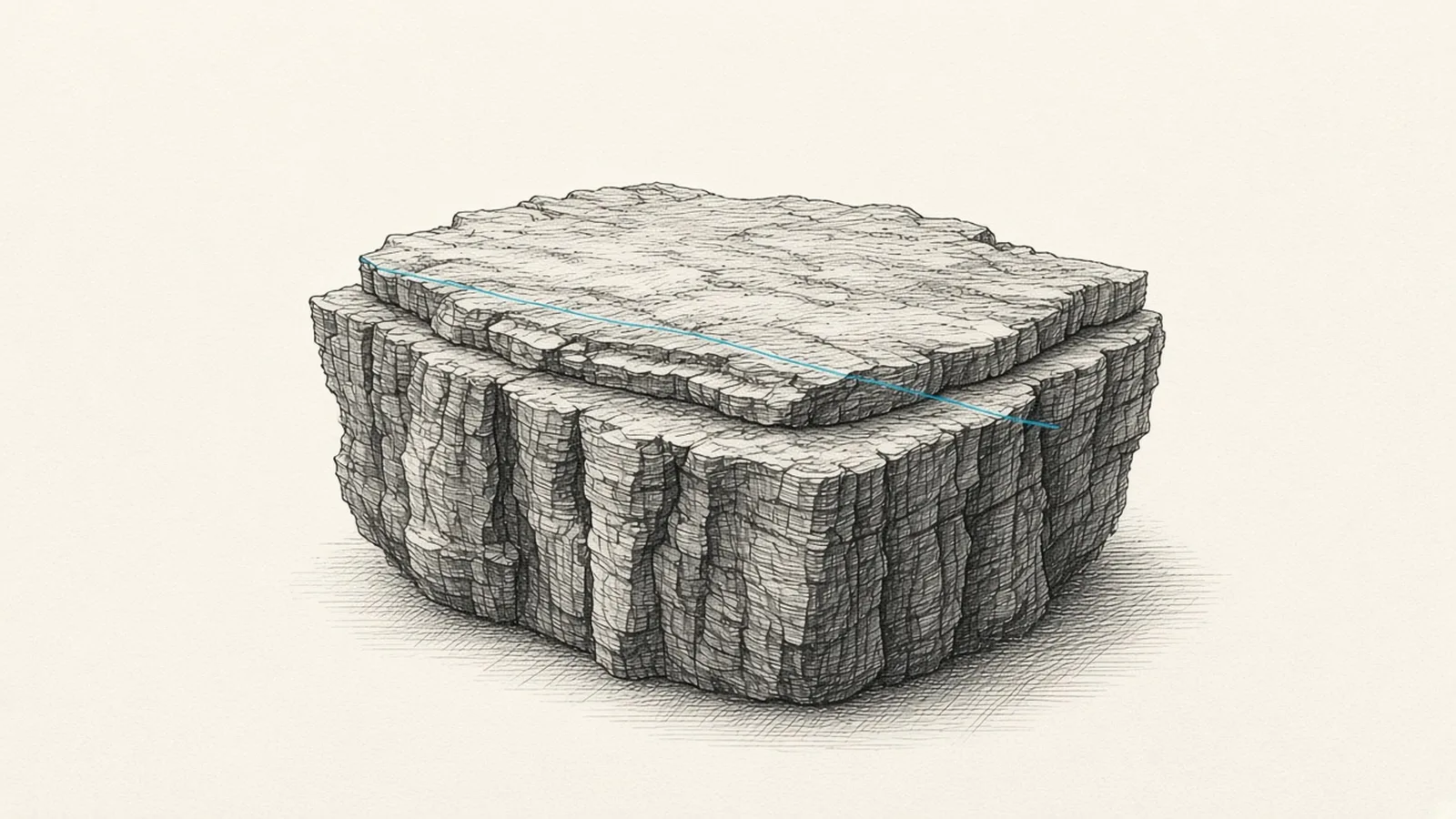
At the beginning of June 1788 three men took a boat from Dunglass and followed the Berwickshire cliffs eastwards, on the east coast of Scotland. They were the geologist James Hutton, the mathematician John Playfair and Sir James Hall, whose home was at Dunglass. Hutton was looking for a precise spot: a place where two rocks of different ages met in the wrong way. He found it on a headland called Siccar Point, "a beautiful picture of this junction washed bare by the sea".
Below, thin beds of grey sandstone, greywacke, stand almost vertical, like the pages of a book stood on end. Their tops are cut flat. Above, resting on that cut, beds of red sandstone lie almost horizontal, only slightly tilted. Hall sketched it on the spot. The drawing, and the rock, are still there.
Sixty-five million years in a single line
Today we can read that line with numbers. The vertical beds are marine sediments of the early Silurian, laid down about 435 million years ago on the floor of an ocean that separated Scotland from England, the Iapetus. That ocean closed; the beds were buried, hardened, folded almost upright, lifted and worn down by erosion to a flat surface. Then, in the late Devonian, about 370 million years ago, rivers flowing from mountains already eroded spread red sands over them. Between the page below and the page above, about 65 million years are missing. They are not written anywhere: they are the line itself.
Hutton did not have these numbers. He had the sequence: deposition on the sea floor, hardening, uplift, erosion, new deposition. Every step needed times as slow as those he saw at work around him, and the cycle had happened at least twice in the same stone. His Theory of the Earth, read to the Royal Society of Edinburgh in 1785 and printed in 1788, ends with a sentence that became famous: "we find no vestige of a beginning, no prospect of an end".
Vertigo as a measuring instrument
Seventeen years later, Playfair remembered that morning in the boat. He wrote that they had felt carried back to a time when the rock they stood on was still at the bottom of the sea, and that "the mind seemed to grow giddy by looking so far into the abyss of time". He added that they had understood how much further reason may sometimes go than imagination may venture to follow.
The myth here touches a modest object: a wet cliff. There is no monument, no inscription, only an angle between two sets of beds. And yet that angle works like an instrument. It does not measure time in years; it measures the distance between what we can imagine and what we can prove. It is the same distance that Thinking Against Cosmic Scale asks us to keep open: to look at deep time without getting lost, and without ceasing to measure.
In the site's Planet Forge a planet with oceans and continents is born in an instant from a seed, and the same seed always gives the same world. It is a good game precisely because it is the opposite of Siccar Point: there the land is not generated, it accumulates, folds and wears away, and the result cannot be made again. Like the dot of Earth seen by Voyager in Less Than a Pixel, the cliff makes whoever looks at it smaller and at the same time gives them something precise to count. In 2022 the International Union of Geological Sciences put it first in its list of one hundred geological heritage sites.
Sources: Hutton's Unconformity and Siccar Point, Wikipedia (accessed 13 November 2026); James Hutton, "Theory of the Earth", Transactions of the Royal Society of Edinburgh, vol. 1, 1788; John Playfair, "Biographical Account of the Late Dr James Hutton", Transactions of the Royal Society of Edinburgh, vol. 5, 1805; Andrew Kerr, "Hutton's Unconformity at Siccar Point, Scotland", Geoscience Canada, 45 (1), 2018.
> ln -s ./linked-nodes
- [PART OF] Cosmic Scale
- [RELATED] Thinking Against Cosmic Scale
- [RELATED] Planet Forge