Reboot: a mythology of civilizations that forget
Reboot is born from a question: what remains of a civilization when it loses the ability to understand its own machines?
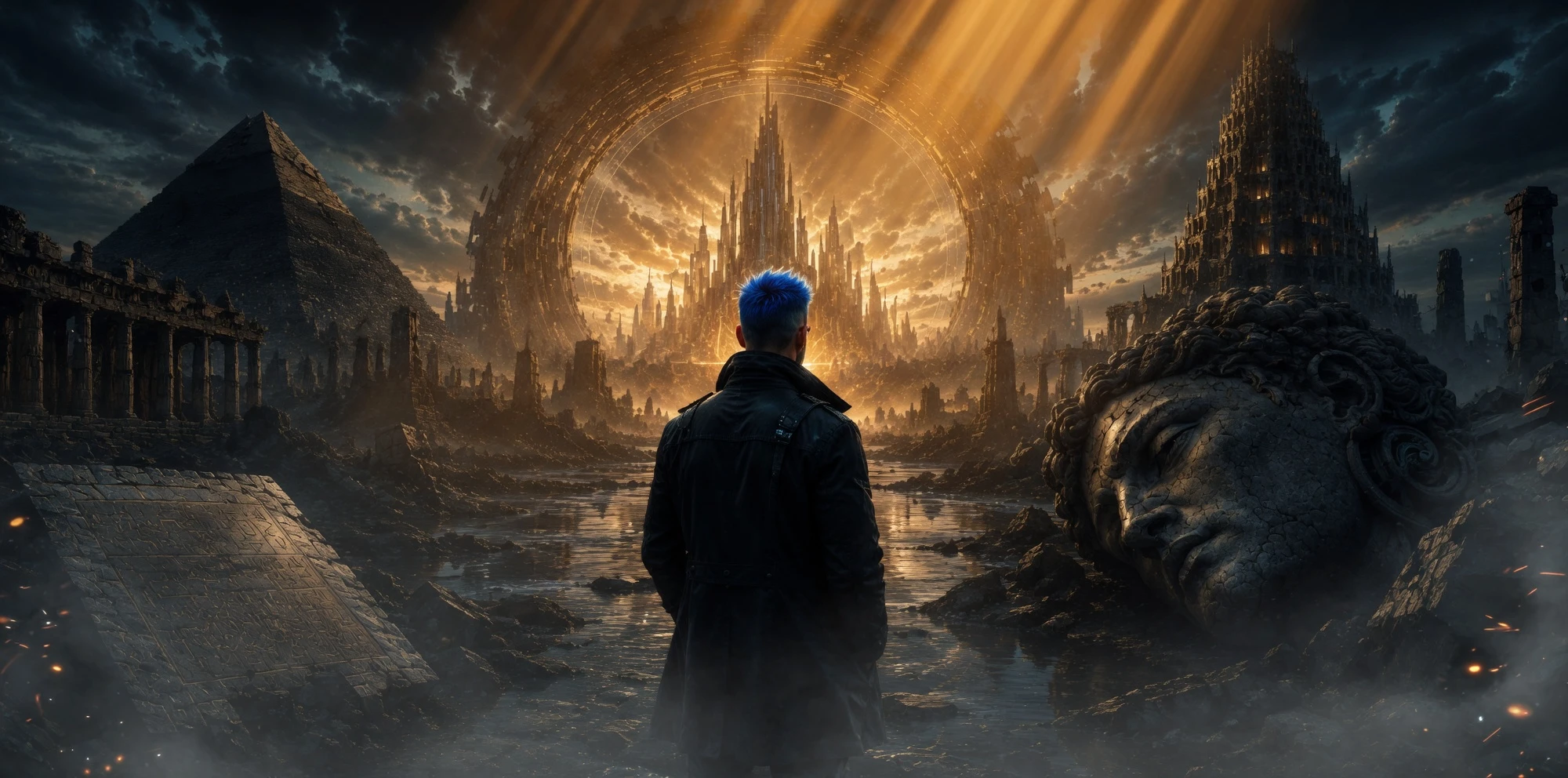
Every civilization calls the previous civilization's technology «myth», until it builds its own.
This sentence is the starting point of Reboot: not an archaeological theory, not a promise of revelation, but a narrative lens for observing the relationship between technology, memory and collapse.
We live in an age when machines are everywhere, but they rarely appear as machines. They are environments. They are interfaces. They are invisible infrastructures. They orient us, measure us, archive us, recommend what to watch, what to buy, who to meet, where to go, how to work. They no longer inhabit only factories or laboratories. They inhabit culture.
And when a technology enters culture, it stops being just a tool. It becomes a symbol.
Fire was never only combustion. It became the gift stolen from the gods. The ship was never only transport. It became exile, conquest, return. Writing was never only recording. It became law, memory, revelation. Electricity was never only current. It became modernity, illumination, nightlife, invisible presence.
Today the same transformation is happening with artificial intelligence, blockchain, digital networks, data centers, cryptographic keys, generative models. Technical objects become inner images. A wallet becomes a safe. An algorithm becomes a judge. A language model becomes an oracle. A server becomes a place of power that almost no one sees.
Reboot is born here: at the point where a civilization notices that its own machines are becoming myth before they even become ruin.
The hypothesis
The hypothesis is simple and unsettling. Perhaps civilizations do not advance only in a straight line. Perhaps there are recurring thresholds. Every civilization reaches a moment when it builds tools more powerful than its own capacity to govern them: energy, automation, weapons, networks, artificial intelligences, biotechnologies. At that point inventing is no longer enough. It becomes necessary to learn how to safeguard.
Not all of them succeed.
Some civilizations collapse spectacularly. Others perhaps more quietly: delegating too much, automating too much, losing skills, becoming dependent on systems no one knows how to repair or question. Then forgetting arrives. Not everything disappears. Buildings, symbols, fragments, texts and shapes remain. The next civilization inherits the shells, but not always the instructions.
And so it interprets.
A machine without context becomes a mystery.
A manual without language becomes a sacred text.
A procedure without infrastructure becomes a rite.
A technical place becomes a temple.
Mirrors, not proofs
This series does not want to prove that Atlantis was real or that the pyramids were technological devices. It wants to do something more interesting: use those images as mirrors. Ask ourselves why we keep imagining lost civilizations, deluges, towers, forbidden fires, technical gods and cosmic punishments.
Perhaps because, deep down, we know that we too could become incomprehensible.
Our archives look eternal, but they depend on formats, servers, energy, passwords, companies, standards and maintenance. Our systems look intelligent, but often we no longer know how to explain how they reach their conclusions. Our cities look solid, but they are crossed by invisible networks without which they would stop within a few days.
Reboot is a technological mythology of collapse and memory.
It does not speak only of lost civilizations. It speaks of our own. Of the possibility that one day what we now call infrastructure will be called legend. And of the responsibility, perhaps, of becoming the first civilization capable of recognizing the cycle before repeating it.
> ln -s ./linked-nodes
- [PART OF] The Machine, the System, the Eras, the Frequency, the AI
- [PART OF] Technological Mythology
- [REFERENCED BY] The Machine, the System, the Eras, the Frequency, the AI