The Sky in a Box: the Wright Brothers' Wind Tunnel
In 1901 the Wrights stopped trusting the tables and built a wooden box with a fan: a piece of sky more reliable than the books.
At the end of the summer of 1901, on the way home from Kitty Hawk to Dayton, Wilbur Wright told his brother Orville that man would not fly for a thousand years. The summer on the North Carolina dunes had gone badly. Their glider, built with a much larger wing than the year before, carried about a third of the lift the calculations promised. The calculations were not theirs: they came from Otto Lilienthal's tables and from a number, the Smeaton coefficient, that had been used in the lift equation for over a century.
At that point the Wrights had two options: believe the tables and doubt the glider, or believe the glider and redo the tables. They chose the second.
A bicycle wheel and a wooden box
The first experiment was almost a game. They mounted a bicycle wheel horizontally in front of the handlebars, with a small airfoil on one side and a flat plate on the other, sized so that, according to Lilienthal's data, the lift of one would balance the drag of the other. Then they pedalled through the streets of Dayton. The wheel should have stayed still. It turned.
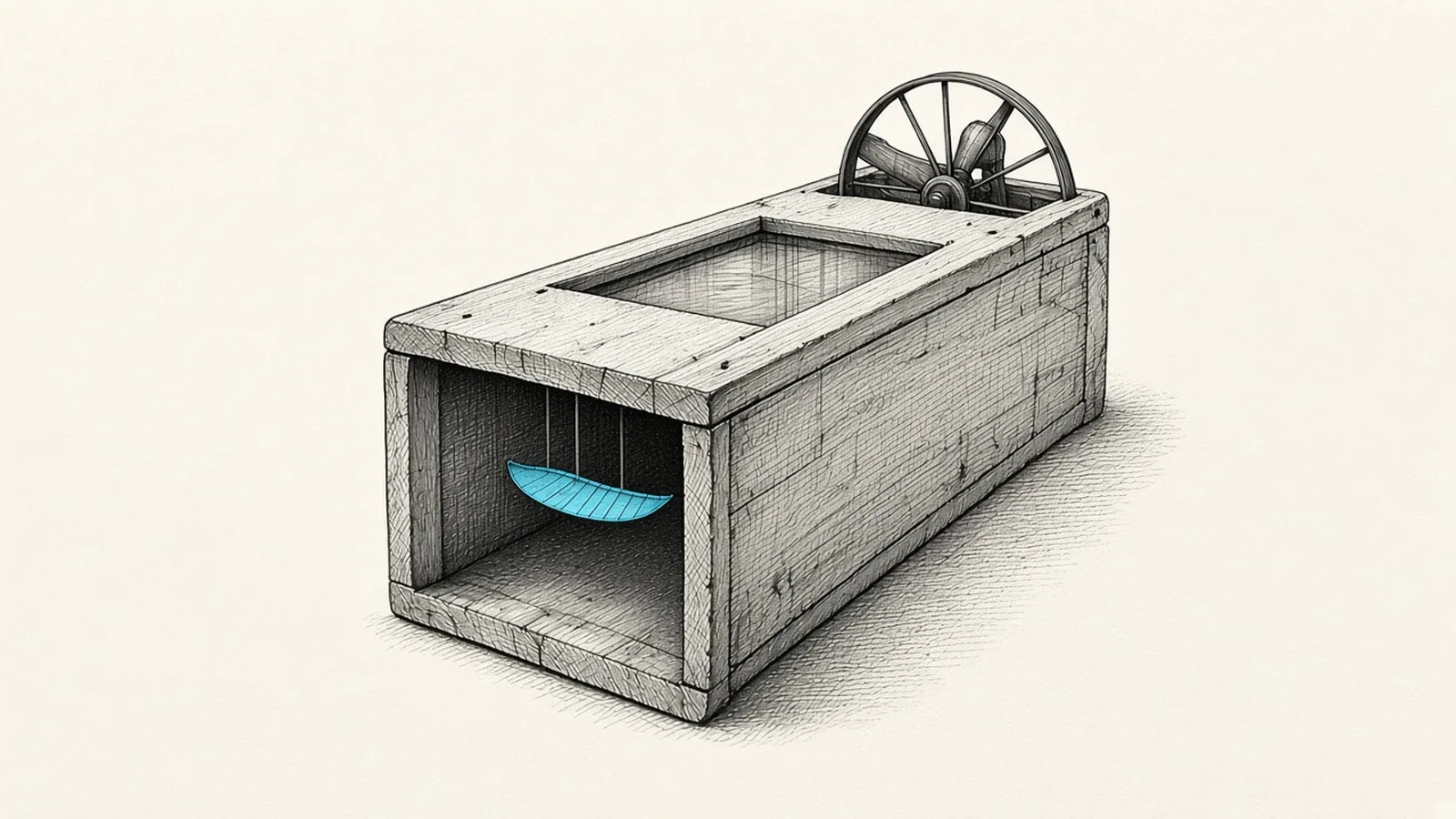
The second experiment was a box. In the bicycle shop they built a wooden wind tunnel about six feet long, with a square section of sixteen inches a side, and a fan blowing air from one end to the other. Inside they put two balances made from whatever was on the bench: bicycle spokes, used hacksaw blades, scrap steel. One measured lift, the other the ratio of drag to lift. Through a small window in the lid they could watch the wing at work.
Between October and December 1901 they tried more than two hundred small sheet-metal wings, flat, curved, long, stubby, single and stacked; then they studied a few dozen of the best in depth, changing only one variable at a time. Two things came out of it. First: the accepted Smeaton coefficient, about 0.005, was too high; the right value was close to 0.0033 (today 0.00327 is used). Lilienthal's data, for the shapes he had measured, were in fact fairly accurate. Second: long, narrow wings performed far better than the short, broad ones they had been using.
The box that corrects the book
The 1902 glider was designed with those numbers, and that autumn it flew more than a thousand times. In 1908 the brothers put it this way: the calculations on which all flying machines had been based were unreliable, every experiment was "simply groping in the dark"; "we cast it all aside and decided to rely entirely upon our own investigations".
The myth here touches an almost ridiculous object: a wooden crate with a fan and two balances made of wire. And yet inside that crate there was a piece of sky reduced to the size of a table, and that piece of sky was more reliable than the books. A simulation is not valuable because it looks like the world; it is valuable because it can be questioned a hundred times, one question at a time, and because its answers can be checked against the ones the world has already given. The Wrights did exactly that: they set the tunnel's numbers beside those of the kites and the glider, and only trusted them when they matched.
It is the same tension that runs through the essay Reality Through Interfaces: every instrument translates reality, and the translation has to be checked against the original. Like Bill Phillips's MONIAC, the Wrights' wind tunnel was a model you could touch; unlike the MONIAC, it did not try to imitate a whole system, but to answer one precise question well. Some of those little sheet-metal wings are still kept at the Franklin Institute in Philadelphia.
Sources: Wright brothers, Wikipedia (accessed 14 November 2026); 1901 Wind Tunnel Tests, NASA Glenn Research Center; 1901 Wright Wind Tunnel, Wright Brothers Aeroplane Company; Orville and Wilbur Wright, "The Wright Brothers' Aeroplane", The Century Magazine, September 1908; Fred Howard, Wilbur and Orville, 1988.
> ln -s ./linked-nodes
- [PART OF] Simulation & Reality
- [RELATED] Reality Through Interfaces
- [RELATED] The Economy Made of Water: Bill Phillips's MONIAC