The Tide Machine: Kelvin and a Sea Made of Pulleys
In 1872 William Thomson built a brass machine that added up waves with a cord and drew a year of tides at the turn of a crank.
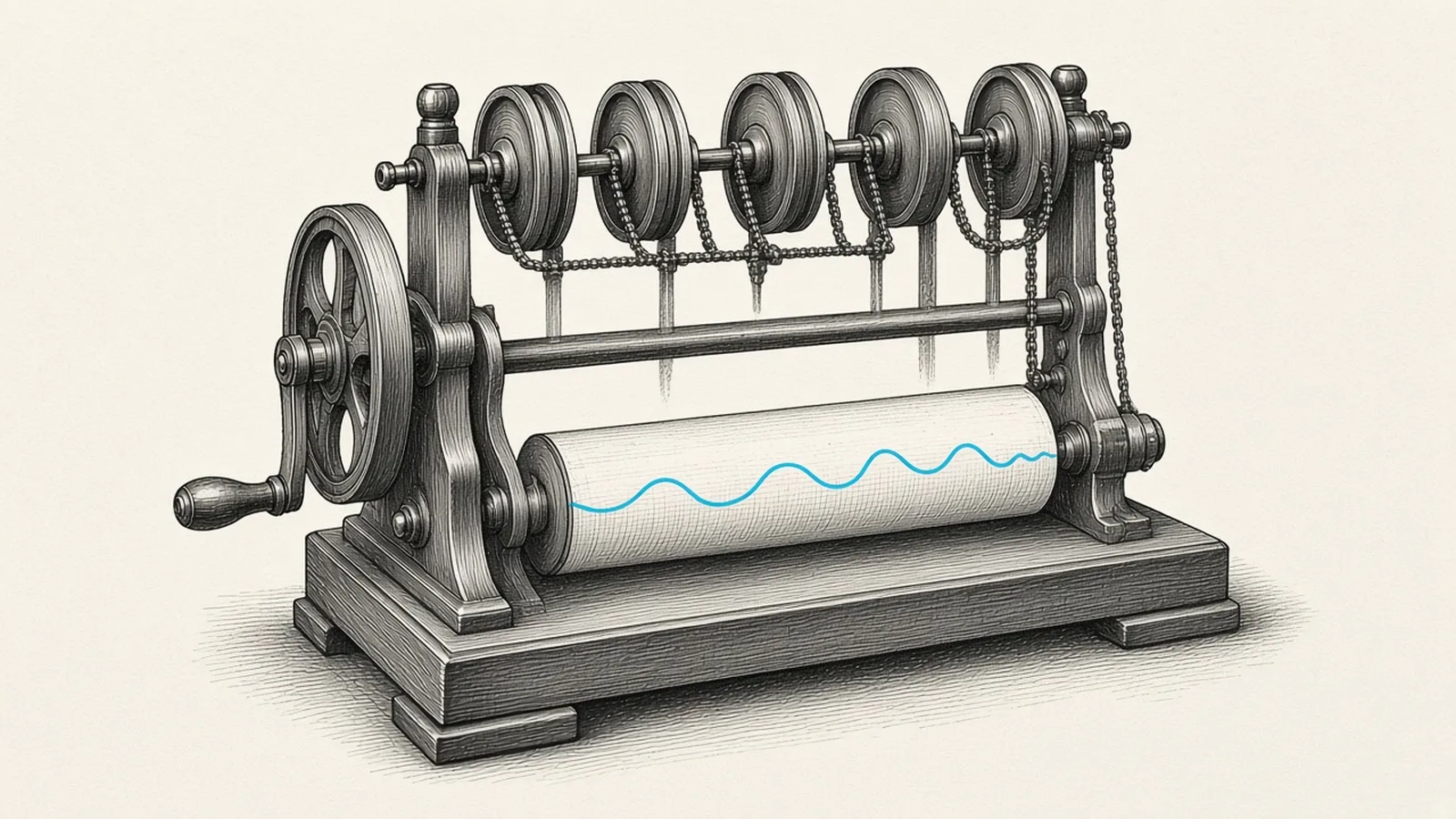
In 1872 William Thomson, the physicist who would later become Lord Kelvin, set himself a problem with nothing abstract about it: knowing in advance at what time, and by how much, the sea would rise in a given harbour. Since Newton it had been known that the Moon and the Sun pull on the oceans. But the tide of a particular port does not obey the sky alone: it also answers to the shape of the coast and the seabed. In the 1860s Thomson had shown how to break it down into a sum of regular waves, each with its own rhythm, amplitude and delay.
The trouble was the arithmetic. Predicting a year of tides meant adding up ten, twenty, sometimes more trigonometric terms, hour by hour, day by day. Done by hand, with pencil and tables, it was a very long job full of chances for error.
A cord that adds up the waves
The answer was a brass machine. Designed by Thomson with Edward Roberts, of the Nautical Almanac Office, and built by Alexander Légé, the first was made in 1872–73; an eight-component model was shown at the British Association in 1873. The principle is almost domestic in its simplicity. Each tidal component is a wheel with an off-centre peg that moves a pulley up and down. A single cord, fixed at one end, runs over and under all the pulleys; the other end, kept taut by a weight, carries a pen. Each pulley takes in or lets out a little cord, and the pen records the sum on a moving band of paper.
The idea of the cord, Thomson acknowledged, had been suggested to him in August 1872 by the engineer Beauchamp Tower, who remembered a device once used by Wheatstone. With the machines of 1876 and 1879 a year of tides for one port could be traced in about four hours. All it took was turning a crank.
Before starting, though, the machine had to be set: the amplitudes and phases of each wheel were the local constants, drawn from years of tide-gauge readings at that port. The sky sat in the gears, always the same. The place sat in the settings. To change port, you changed the machine without taking it apart.
The sea inside a room
These machines did not calculate with numbers. They imitated one phenomenon with another: pulleys in place of the Moon, a cord in place of the water. They belong to the same family as Bill Phillips's MONIAC, which ran water through pipes to show the economy. An analogue simulation does not describe the world: it resembles it closely enough to get ahead of it.
In the United States, the Coast and Geodetic Survey's machine No. 2, nicknamed "Old Brass Brains", entered service in 1912 and was retired in 1965. During the Second World War it was classified along with the data it produced; machines of this kind, descended from Thomson's design, served for the tide predictions of the 1944 Normandy landings. Thirty-three are known to have been built, not counting portable models. Then electronic computers did the same work without brass, and the machines moved into museums.
What remains is an object you can watch for a long time: a row of pulleys rising and falling at different rhythms, none of which is the tide, and a pen that, adding them up, draws it. It is an exact way of saying what I try to describe in Reality Through Interfaces: often we do not touch the sea, but its translation. Thomson's had the merit of being honest. You could see how it worked.
Sources: Tide-predicting machine, Wikipedia (accessed 7 November 2026); W. Thomson, "The tide gauge, tidal harmonic analyser, and tide predicter", Proceedings of the Institution of Civil Engineers, vol. 65, 1881; B. Parker, "The tide predictions for D-Day", Physics Today 64 (9), 2011; P. L. Woodworth, An inventory of tide prediction machines, National Oceanography Centre, 2016.
> ln -s ./linked-nodes
- [PART OF] Simulation & Reality
- [RELATED] The Economy Made of Water: Bill Phillips's MONIAC
- [RELATED] Reality Through Interfaces