Chladni's Sand: the Sound That Lets Itself Be Seen
In 1787 Chladni sprinkled sand on a brass plate and made it ring with a violin bow. The sand did not draw the sound, but the points where the metal stayed still.
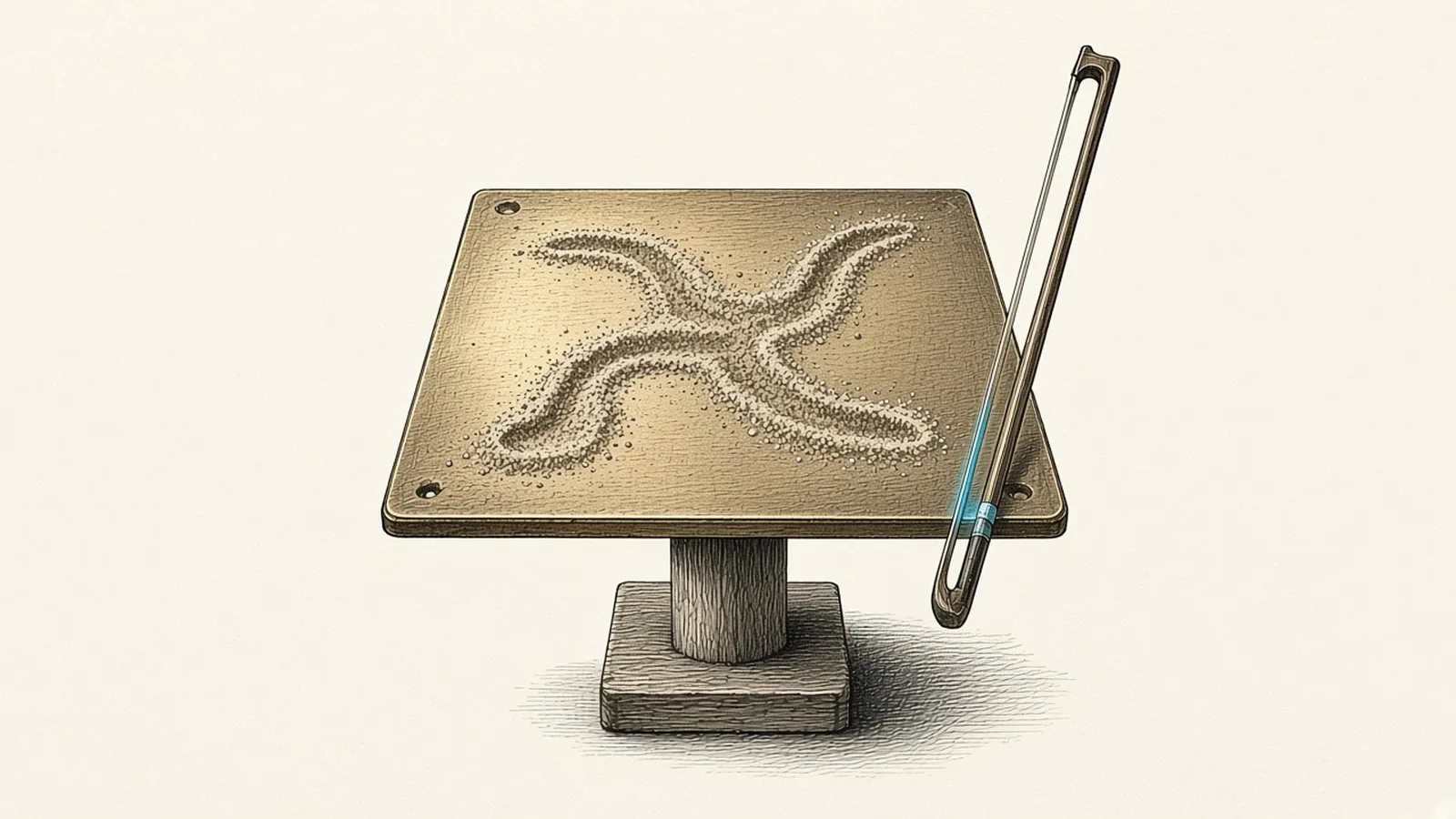
Ernst Florens Friedrich Chladni had noticed something that nobody, he later wrote, had ever bothered to investigate: a glass or metal plate that is not too small gives different sounds depending on where it is held and where it is struck. He wanted to know why. He fixed in a vice, by the pivot at its centre, a brass plate that belonged to a grinding machine, and stroked its edge with a violin bow. The notes were stronger and more lasting than the ones he got by striking it.
He knew the experiments of Lichtenberg, who had made the traces of electric discharges visible by spreading powder on insulators. He tried the same with his plate: he sprinkled it with sand, drew the bow, and within a few seconds the sand formed a star with ten rays. In 1787, in Leipzig, he published these observations in Entdeckungen über die Theorie des Klanges, discoveries on the theory of sound.
Where the plate stays still
When the plate sounds, almost all of its surface vibrates. Not all of it, though: some lines do not move, the nodes. The sand is thrown off the vibrating areas and gathers along the still ones. Every note has its own figure, and changing the point where the plate is held or where it is bowed changes the drawing.
Chladni was not the first to see it. Leonardo da Vinci had noted the phenomenon in his notebooks and Galileo had written about it in the Dialogue Concerning the Two Chief World Systems. But he was the first to study it systematically. With no chair and no regular income, he also made a living from it: he toured Europe with his plates and showed the figures in public.
In 1809 he showed them to Napoleon in Paris. A prize from the Institut de France followed, for a mathematical theory of elastic surfaces that could explain those figures, with a one-kilogram gold medal worth 3,000 francs. Lagrange thought the mathematics of the time was not up to it, and hardly anyone tried. Sophie Germain, who had taught herself and could not enrol at the École Polytechnique because she was a woman, was the only entrant in 1811, and did not win. In 1813 she received an honourable mention. In January 1816 the prize was hers, even though her derivation was still incomplete.
A figure, not the sound
What strikes me about Chladni's plate is that the sand does not show the sound. It shows where the sound is not. The drawing is made of stillness: of all the points where the metal, for an instant, stays put while the rest trembles. To see a vibration you have to look at its motionless shadow.
It is the same question I ask in the essay on reality passing through interfaces: every representation translates, and the translation chooses what to leave out. The Sound → Matter tool on this site also makes a cloud of particles react to sound, but it says so openly: it is an artistic visualisation driven by the signal's spectrum, not a physical simulation. Chladni's sand, on the other hand, interprets nothing. It falls where it has to fall. Perhaps that is why, more than two centuries later, those stars of sand still look like a writing that matter leaves on its own, with no one dictating it.
Sources: Hans-Jürgen Stöckmann, Chladni meets Napoleon, The European Physical Journal Special Topics 145, 2007; J. J. O'Connor and E. F. Robertson, Sophie Germain, MacTutor History of Mathematics, University of St Andrews (accessed 27 October 2026).
> ln -s ./linked-nodes
- [PART OF] Simulation & Reality
- [RELATED] Sound → Matter
- [RELATED] Reality Through Interfaces