The Golden Record: a Song Cut for an Era We Will Never See
The Voyager Golden Record carries instructions, a needle and a uranium clock: a song meant for an era we will never see.
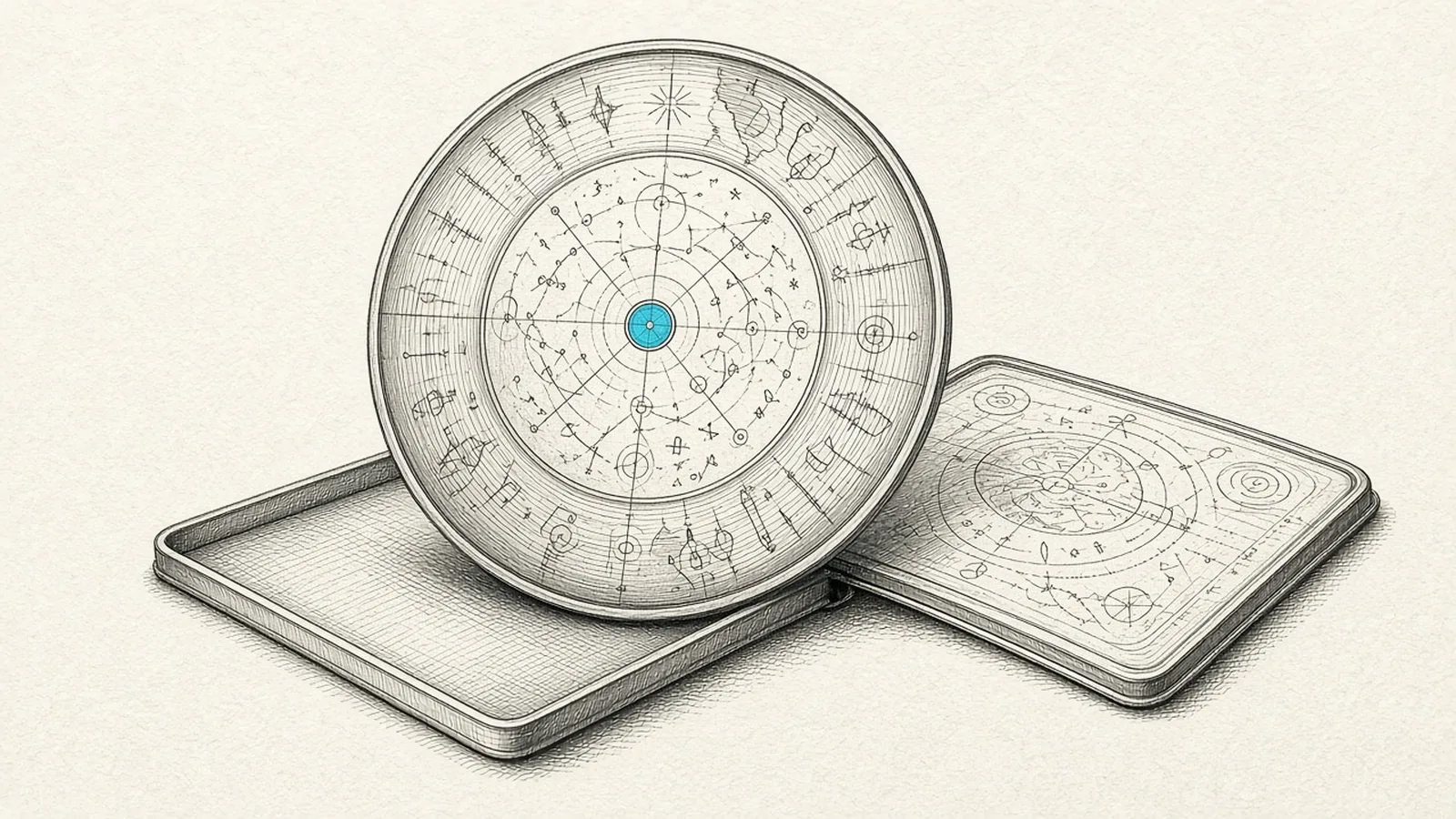
In 1977 two probes left for the edge of the solar system, each carrying an object that served no purpose for the mission. A phonograph record of gold-plated copper, thirty centimetres across, sealed in an aluminium case together with a cartridge and a needle. It is the Voyager Golden Record. It is the opposite of a radio signal: it does not travel at the speed of light, it does not disperse, it does not ask to be heard now. It waits.
A committee chaired by Carl Sagan chose what to cut into it: 115 images encoded in analog form, sounds of Earth such as surf, wind, thunder, birds and whales, ninety minutes of music from different cultures and eras, greetings in fifty-five languages. The first greeting is in Akkadian, which NASA describes as spoken in Sumer about six thousand years ago. The last is in Wu, a modern Chinese dialect. The record already begins as an archive of eras.
The manual engraved on the cover
The most eloquent part is not the content but the cover. Whoever found it would have no one beside them to explain what they were holding. So the aluminium carries engraved instructions, in a symbolic language: where the probe comes from, how the record is played, how fast it must turn, sixteen and two-thirds revolutions per minute. The manual was fixed to the object, because there would have been no other way to pass it on.
An ultra-pure sample of uranium-238, with a half-life of about 4.47 billion years, was also deposited on the cover. It lets whoever finds the record work out how long it has been travelling. It is a clock for a reader whose era nobody knows. A dedication was also hand-etched on the surface of the record: "To the makers of music – all worlds, all times".
A song outside its own era
According to NASA, it will be about forty thousand years before the probes come close to another planetary system. Sagan said it without illusions: the record will be found and played only if there are advanced spacefaring civilizations in interstellar space. And he added that launching this bottle into the cosmic ocean says something very hopeful about life on this planet.
It is the problem of The Song of the Eras, seen from the other side. There we ask whether we are listening in the wrong century. Here it is we who sing for a century we will never see. A hand that one day opened that case would not meet whoever closed it. It would meet an object, an instruction and a uranium clock. The conversation, if it ever happens, will be between two eras that never touch.
The Golden Record is an honest object precisely for this reason. It does not demand an answer. It accepts asynchrony and tries to outlive it: copper, gold, aluminium, a needle in the same box, the way of reading bound to the thing to be read. The Song of the Eras starts here, from asynchrony as the first wound of every contact. The record is the most human answer I know to that wound: not to close the distance, but to leave inside the object everything needed to cross it.
Sources: NASA Science, Golden Record Contents, Making of the Golden Record and The Golden Record (science.nasa.gov/mission/voyager); C. Sagan, F. Drake, A. Druyan, T. Ferris, J. Lomberg, L. Salzman, Murmurs of Earth, 1978.
> ln -s ./linked-nodes