The Noise That Would Not Go Away: the Holmdel Horn and the Oldest Light
In 1964 a Bell Labs antenna picked up a hiss that would not disappear, even after the pigeons were removed. It was the oldest light in the universe.
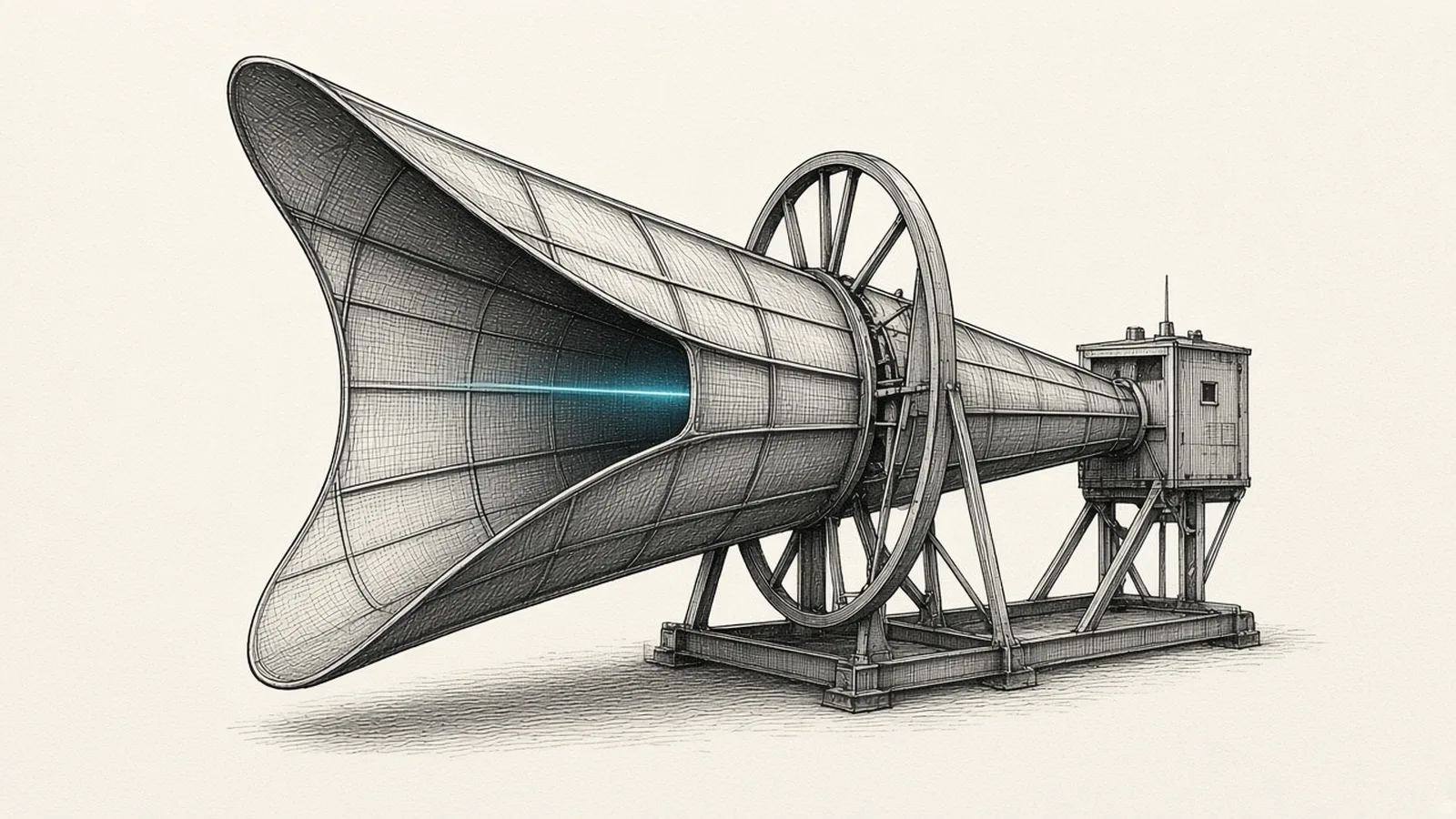
On Crawford Hill, in Holmdel, New Jersey, Bell Telephone Laboratories built a strangely shaped antenna in 1959: an aluminum horn fifty feet long, with a square mouth twenty feet on each side, set into a large vertical wheel that let it point at any part of the sky. It served Project Echo, NASA's balloon satellites that bounced radio signals back to Earth like mirrors. It was an ear built to listen for one specific thing.
In 1964 two radio astronomers, Arno Penzias and Robert Wilson, used it for another job: measuring faint signals from the sky precisely. To do that they had to remove everything that was not sky. They eliminated radar and radio broadcasts, and cooled the receiver with liquid helium to about four degrees above absolute zero. A noise remained.
The noise that would not go away
It was low, steady, the same in every direction, day and night. It did not follow the Sun or the Milky Way. Penzias and Wilson checked the apparatus piece by piece. Some pigeons had nested inside the horn; they removed them and cleaned out the droppings that had built up on the walls. The noise remained.
Sixty kilometres away, at Princeton, Robert Dicke, Jim Peebles and David Wilkinson were getting ready to look for exactly that: if the universe was born hot and dense, it must have left behind radiation, stretched by expansion down to microwaves by now. An MIT physicist, Bernard Burke, told Penzias about an unpublished paper by Peebles. Penzias phoned Dicke and invited him to hear the noise. In July 1965 the Astrophysical Journal published two notes side by side: Princeton's with the interpretation, and Penzias and Wilson's with the measurement, titled without emphasis "A Measurement of Excess Antenna Temperature at 4080 Mc/s". An excess of about 3.5 kelvin. The Nobel Prize in Physics followed in 1978.
Today that radiation is called the cosmic microwave background. Later measurements fixed it at 2.725 kelvin. It is light that set out about 380,000 years after the Big Bang, when the universe became transparent: the oldest light there is to see.
An ear bigger than the question
The myth here touches an object made of sheet metal. The Holmdel horn was built for a telecommunications task, and its shape, walls that shield it almost entirely from the heat of the ground, made it fit for something much farther away. The instrument could listen to more than its designers asked of it. It was not looking for the beginning of the universe; it found it because it was well made and because two people refused to call "fault" what they did not understand.
It is the same discipline that runs through Thinking Against Cosmic Scale: faced with the enormous, serious work is small and stubborn. Cleaning an antenna, removing pigeons, checking a receiver again. And then accepting that the residue, what is left after everything else has been removed, is the data. It is also the problem of listening that The Song of the Eras deals with: a signal can cross almost the whole history of the universe and arrive as a hiss nobody is waiting for.
The antenna is still there. In 1989 it became a National Historic Landmark; since 1992 the receiver and calibration equipment have been at the Deutsches Museum in Munich, Penzias's birthplace. In 2021 the land was sold to a developer; after a petition and a lawsuit, in January 2024 Holmdel Township completed the purchase of the horn and the land around it to turn it into a park. A civilization that keeps the ear with which it heard its own origin does at least this much: it leaves those who come after the object, not just the story.
Sources: A. A. Penzias and R. W. Wilson, A Measurement of Excess Antenna Temperature at 4080 Mc/s, Astrophysical Journal 142, 419–421, 1965; Holmdel Horn Antenna, Discovery of cosmic microwave background radiation and Cosmic microwave background, Wikipedia (accessed 16 November 2026).
> ln -s ./linked-nodes
- [PART OF] Cosmic Scale
- [RELATED] Thinking Against Cosmic Scale
- [RELATED] The Song of the Eras: the cosmic problem of time and listening