Cavendish's Closed Room: Weighing the Earth with a Wire
In 1798 Henry Cavendish measured the Earth's density with a wooden arm, two lead balls and a wire, watched from outside through a telescope.
In the second half of the eighteenth century the Reverend John Michell, an English geologist, imagined a way to make visible the attraction between small quantities of matter. He built the apparatus, but finished it shortly before he died and never got to use it. It passed to the Cambridge professor Francis John Hyde Wollaston, who had no suitable place for the experiments and gave it to Henry Cavendish. In 1797, at sixty-seven, Cavendish began to measure.
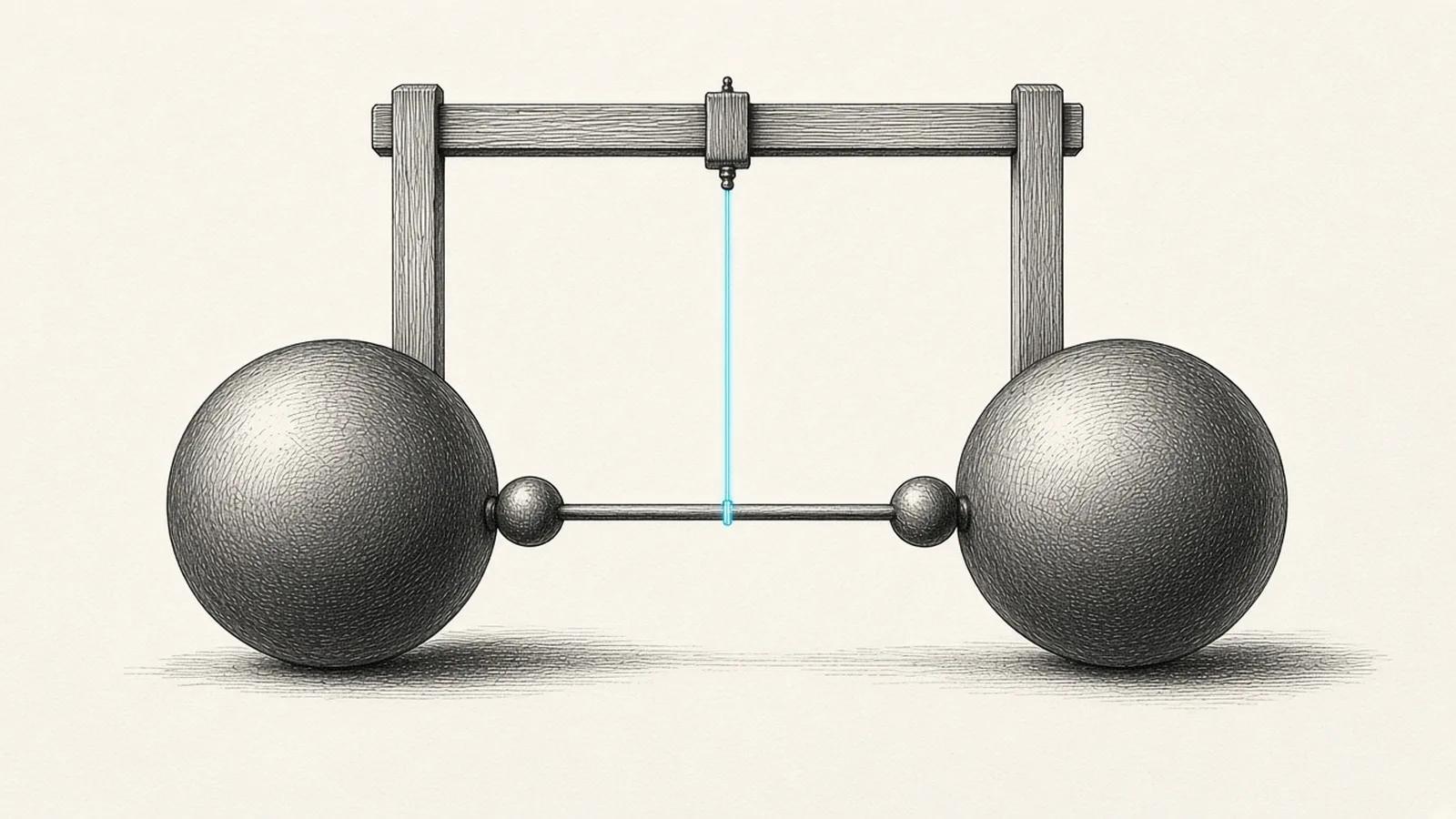
The apparatus, he wrote, was very simple. A wooden arm six feet long, light and strong, hung horizontally from a slender wire forty inches long. At each end a lead ball about two inches across. The whole thing shut inside a narrow wooden case, to defend it from the wind. Two lead spheres twelve inches across, about 158 kilograms each, could be brought beside the small balls. If gravity acts between all masses, the large spheres should pull the small ones toward them, and the arm should turn by a tiny amount, twisting the wire.
A room nobody enters
The force involved was so weak that a draught was enough to erase it. Cavendish shut the apparatus in a room and stopped going in. He watched the arm from outside, through a telescope aimed through a window, and moved the large spheres with a system of pulleys worked from outside. The room was kept dark, because even a difference in temperature between one corner and another could stir the air. He watched the slow swings of the arm for hours. He turned the spheres in case they had become magnetised, tried different wires, hunted down every cause that might imitate the attraction without being it.
In June 1798 he published a fifty-seven-page paper in the Philosophical Transactions of the Royal Society, titled Experiments to Determine the Density of the Earth. The result: the Earth is 5.48 times denser than water. The accepted value today is 5.52. In the same paper Cavendish does not hide his doubt: the measurements agree fairly well, but they differ more than observation error can explain, and the cause is perhaps the air currents. Then he lists the trials made in different weather and at different temperatures, and concludes that the error is unlikely to act always in the same direction.
Weighing a planet from a dark room
What strikes me is the disproportion. On one side a wooden arm, two small balls, a wire and a dark room in England. On the other the mass of an entire planet, which nobody will ever put on a scale. Between the two there is only a minute twist, read from a distance by a man who had decided not to breathe near his instrument.
It is the gesture the essay Thinking Against Cosmic Scale tries to describe: not letting size crush you, but finding the small point where size lets itself be measured. Today Cavendish's experiment is read as a measurement of the universal gravitational constant, and physics students repeat it with the same layout. In this site's Gravity Sandbox the same force moves planets and stars with a click. In that closed room, in 1798, it was barely enough to turn a wooden arm.
Sources: Henry Cavendish, Experiments to determine the density of the earth, Philosophical Transactions of the Royal Society of London, 1798; June 1798: Cavendish weighs the world, APS News, American Physical Society, June 2008 (accessed 25 October 2026).
> ln -s ./linked-nodes
- [PART OF] Cosmic Scale
- [RELATED] Gravity Sandbox
- [RELATED] Thinking Against Cosmic Scale