Less Than a Pixel: Earth Seen by Voyager 1
On 14 February 1990 Voyager 1 looked back: Earth was 0.12 pixel inside a ray of scattered light. A measure of cosmic scale.
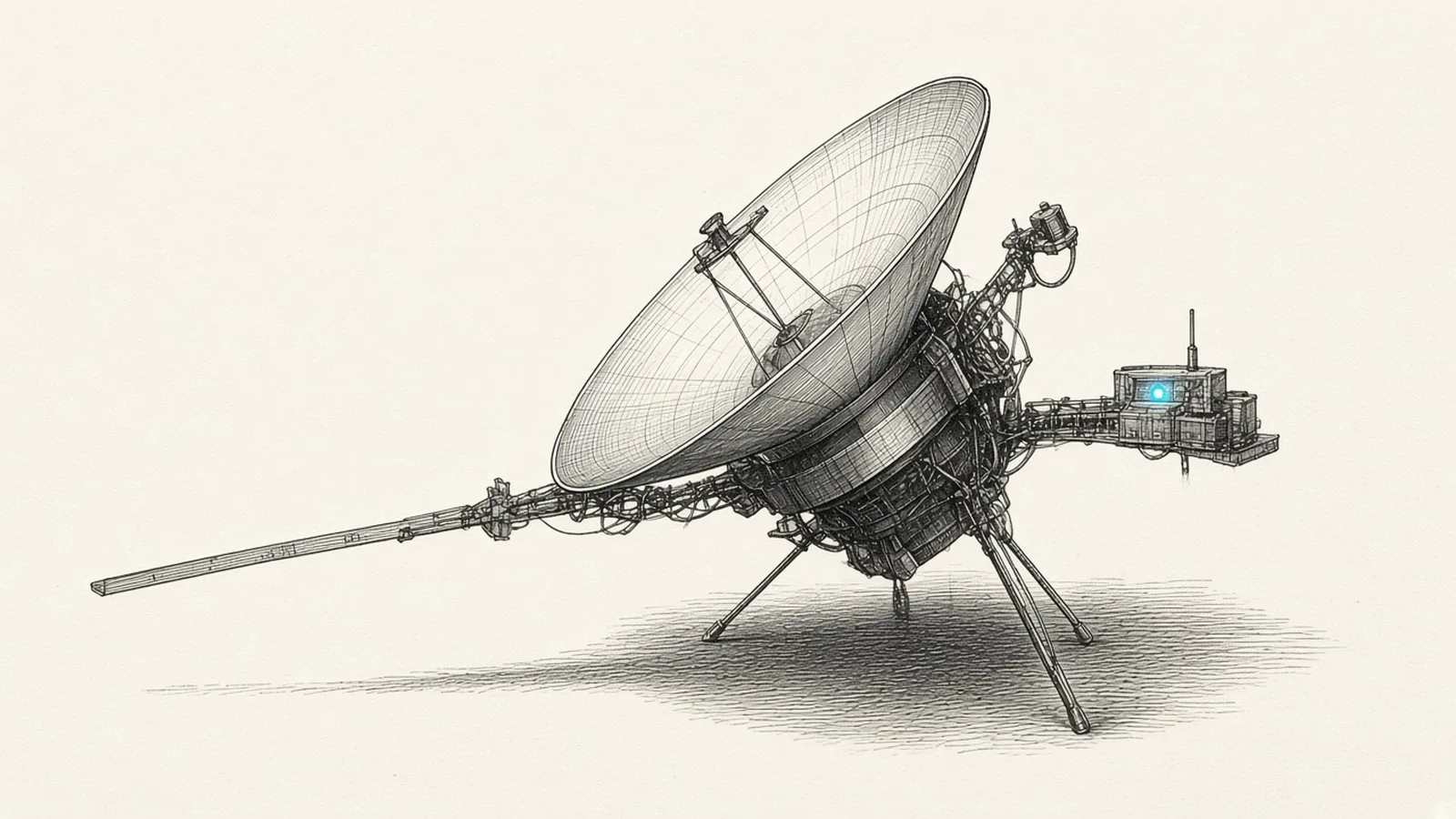
On 14 February 1990, at 04:48 GMT, the Voyager 1 probe turned its cameras toward home. It was beyond Neptune, about six billion kilometres from the Sun. Mission managers had commanded it: look back one last time, before the cameras are switched off for good, to save power and because the probe, like its twin Voyager 2, would no longer meet anything to photograph up close.
Sixty images came out of it, designed to make a "family portrait" of the solar system: six planets and the Sun. The one that would be named Pale Blue Dot was taken thirty-four minutes before shutdown.
Less than a pixel
NASA is exact about what can be seen, and the exactness is the hardest part. Earth, in the narrow-angle camera, was less than one picture element: a crescent 0.12 pixel wide. Not a sharp speck, but a point the photograph cannot even resolve. And by coincidence, the JPL catalogue says, it fell in the middle of one of the scattered rays of light that the Sun, so close to the frame, produced inside the optics.
That is why the photo had not been taken earlier. The inner planets sit a few degrees from the Sun, and the Sun was bright enough to damage the cameras. The scientific fact was also a safety condition: looking at home meant looking almost against the light.
Then there is time. The images did not arrive at once: it took four passes with the Deep Space Network, and everything was down only on 1 May 1990, almost three months after the shot. Earth had been photographed by a machine that could no longer look at it again.
The line that remains
Carl Sagan took the title of his book from it, Pale Blue Dot: A Vision of the Human Future in Space, and wrote in it: "Look again at that dot. That's here. That's home. That's us." It is a sentence quoted until it wears out. It is worth going back to the object: a point below the threshold of resolution, inside a ray that is a flaw of the optics.
In 2020, for the thirtieth anniversary, JPL published a version reprocessed with modern software, "attempting to respect the original data and intent of those who planned the images." There too Earth remains a single bright pixel. The processing changes the colour balance, not the distance.
Cosmic scale, here, is not a big word. It is a measurement with a tiny unit: 0.12. Everything we have built, written, lost and remembered sits inside that fraction of a pixel. It does not become irrelevant, it becomes legible as what it is: a place, photographed once, from very far, by a machine about to be switched off. Thinking Against Cosmic Scale speaks of it too, and so does The Golden Record, about the disc that travels on the same probe.
Sources: NASA Science, Voyager 1's Pale Blue Dot; NASA/JPL, Pale Blue Dot Revisited (PIA23645); NASA Photojournal, catalogue PIA00452.
> ln -s ./linked-nodes
- [PART OF] Cosmic Scale
- [RELATED] Thinking Against Cosmic Scale
- [RELATED] The Golden Record: a Song Cut for an Era We Will Never See