The Lens Cut in Two: Bessel and the First Distance to a Star
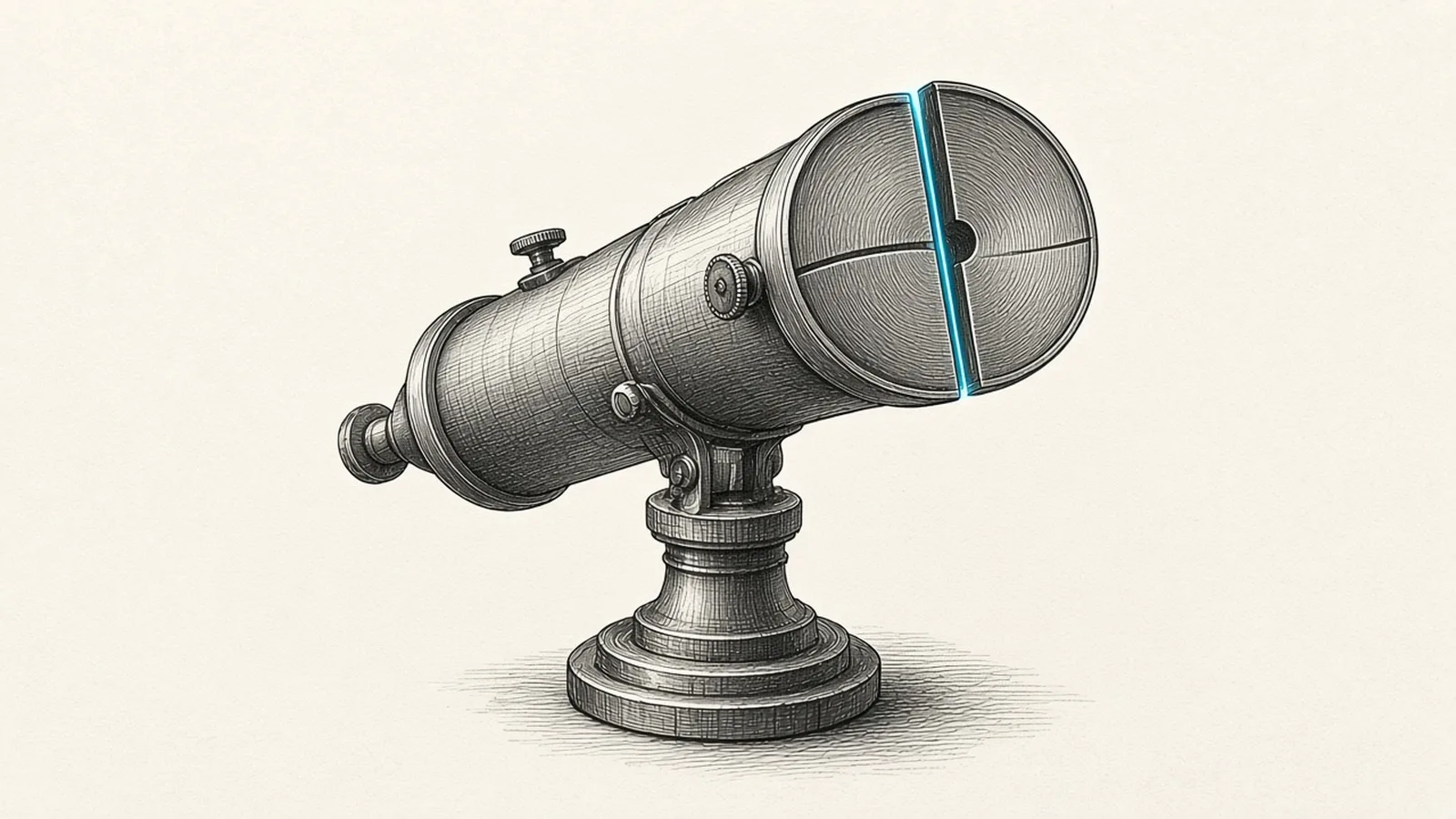
In 1838 Bessel was the first to measure the distance to a star, 61 Cygni, with a Fraunhofer telescope whose lens had been cut in half.
For centuries astronomers knew what they ought to see, and they did not see it. If the Earth goes around the Sun, a nearby star observed six months apart must shift very slightly against the more distant stars behind it. This is parallax, the same shift we see when we close one eye and then the other in front of a raised finger. For the stars the shift was so small that no instrument could catch it. In 1838 Friedrich Wilhelm Bessel, director of the Königsberg Observatory in Prussia, opened his letter to John Herschel with these words: after so many unsuccessful attempts to determine the parallax of a fixed star.
A lens cut in two
The instrument he needed had been built by Joseph Fraunhofer, the finest optician of his day. It was the last telescope he designed, and it reached Königsberg after his death in 1826. It was a heliometer with a six-inch aperture, and it looked like any other refractor. But its objective, the most precious lens, had been cut in half with a diamond point. The two half-lenses could slide alongside each other by turning a calibrated micrometer screw. So in the eyepiece the image doubled. Bessel moved the halves until the image of a nearby star sat exactly on that of a distant one, and read on the screw how far he had had to separate them.
He chose 61 Cygni, a star in the Swan that moved across the sky faster than almost any other, a sign that it might be close. It was also a double star, easier to point at precisely, and near enough to the pole to stay visible at night for most of the year. He began in September 1834 with two faint stars as references, but the air was seldom clear enough and he had to choose brighter ones. In 1835 pendulum measurements in Berlin kept him away for three months and, when he returned, Halley's Comet claimed every clear night. In 1836 other calculations absorbed him. The decisive series only came later, between 1837 and 1838.
A shift of a third of a second
In just over a year Bessel took more than a hundred measurements of the position of 61 Cygni against each of the two comparison stars, and combined them by least squares, by hand. A modern analysis of those data redid the calculation and got almost the same result: he had made no mistakes. The star swayed around its own path with the rhythm of the Earth's year. The parallax came out at 0.3136 seconds of arc, with an error of 0.0202. A second of arc is one three-thousand-six-hundredth of a degree. From that third of a second Bessel derived a distance of 657,700 times that between the Earth and the Sun: light, he wrote, takes 10.3 years to cross it. The modern value, measured by the Gaia satellite, is about 11.4 light years.
What strikes me is the object. To measure the distance of a star, the most precious part of the telescope had to be broken, and made to see double on purpose. The measurement lay in neither image, but in the space that had to be opened between them and then closed again. It is the same gesture, on another scale, as Eratosthenes' stick of Alexandria, and the first rung of the ladder that Henrietta Leavitt would extend seventy years later. In the essay Thinking Against Cosmic Scale I write that scale must be inhabited without being crushed by it. Fraunhofer's lens is a small proof of that: a screw, four years of patience, and the sky stops being a painted surface and becomes deep.
Sources: F. W. Bessel, On the parallax of 61 Cygni, Monthly Notices of the Royal Astronomical Society 4 (1838); American Astronomical Society, This Month in Astronomical History: November 2021; The First Stellar Parallaxes Revisited, arXiv:2009.11913 (accessed 30 October 2026).
> ln -s ./linked-nodes
- [PART OF] Cosmic Scale
- [RELATED] Thinking Against Cosmic Scale
- [RELATED] Henrietta Leavitt's Rhythm: the Stars That Measure Distance
- [REFERENCED BY] Rømer's Eleven Minutes: The Moon of Jupiter That Arrived Late