The Floppy and the Notebook: Two Ways to Keep What You Risk Losing
From the SACCS eight-inch floppy to the Digital Custody Notebooks: a bridge between a machine that could not be replaced and a procedure that must not be forgotten.
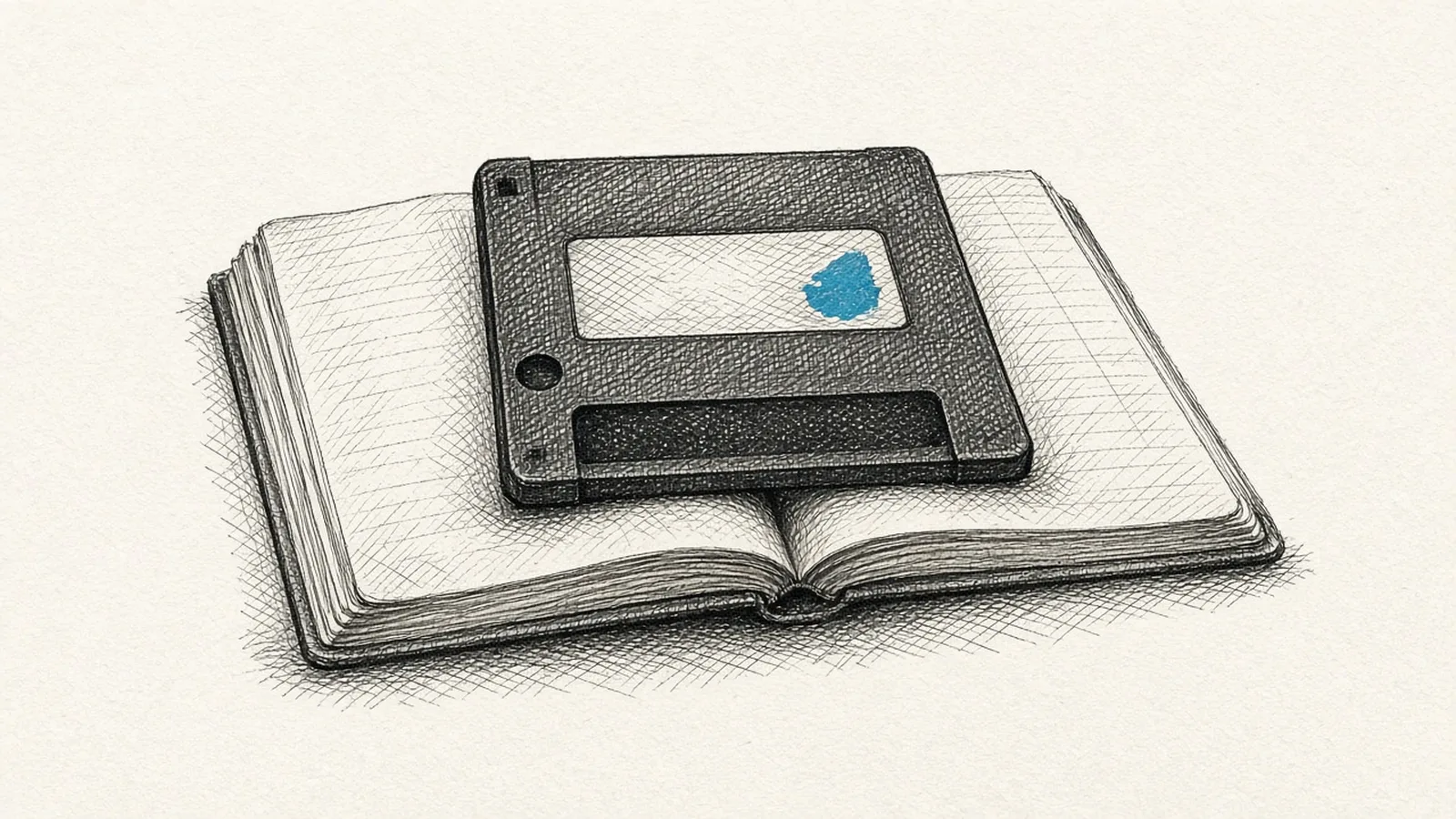
The SACCS eight-inch floppy and the seed phrase of a digital wallet have nothing in common, at first sight. One is a flexible disk in a square sleeve, the other a phrase of words. But both pose the same question: who still knows how to use them, when it matters?
I have written about them in two different places. In the book Reboot, where the floppy case takes up a chapter; and in the Digital Custody Notebooks, where custody is the subject. This article sets them side by side.
The case: an object that could no longer be replaced
I told the SACCS case in another article. The core is enough here. Until 2019 the command and control system of the US nuclear forces still used eight-inch floppies. The GAO described it without rhetoric in 2016. When something broke, someone repaired it. The floppies were retired in June 2019.
The lesson is not about the Pentagon. It is about legibility: a system can stay switched on when its medium is already archaeology. The power remains, the ability to read it leaves first.
The notebook: a procedure that must not be forgotten
The first Notebook, The Custody, starts from the simplest and hardest point: in the digital world, truly owning something also means being able to lose it. Self-custody is not only freedom from intermediaries. It is the acceptance of risk, procedure, memory and verification.
The notebook works on the passage from intuitive ownership to custody as a system. A seed phrase is not an ordinary password. A backup is not a reassuring copy if nobody knows when and how to use it. A hardware wallet is not a safe if the procedure makes recovery impossible.
The text offers no financial, legal or tax advice and suggests no products. It builds a prudent grammar: theft and loss are different risks, and every custody system must balance them consciously.
The bridge
The floppy shows what happens when the procedure is lost while the object remains. The notebook asks us not to get there. In the first case there is a civilization that keeps without knowing how to read any more. In the second, an individual who risks doing the same with what is most their own.
A backup that nobody knows how to use is a floppy in a drawer: a flat, square, mute object. To keep does not only mean to hold. It means to hold together the thing and the way of reading it, and to verify, from time to time, that the way still works.
> ln -s ./linked-nodes