The Copper Tabs: the Bay Model and the Dam That Never Was
In 1957 in Sausalito, the Army Corps of Engineers built a concrete bay to test a plan for dams. A quarter of a million copper tabs made it believable.
In Sausalito, on the north shore of San Francisco Bay, there is a shed that during the Second World War was the warehouse of a shipyard, Marinship. Inside it, since 1957, there is another bay. It is made of concrete: 286 slabs of five tons each, fitted together like the pieces of a jigsaw puzzle, with the shipping channels, rivers, marshes, piers and bridges. When the water runs, the tide rises and falls as it does outside, only faster.
The U.S. Army Corps of Engineers built it to answer one precise question. Since the 1930s a man of the theatre, John Reber, who had come to California from Ohio in 1907, an actor, director and writer of shows, had been proposing to close the bay with two large earth dams. Trains and cars would run on top; behind them, two huge freshwater lakes for the cities and the fields. Reber had no engineering training, but he knew how to talk to committees. In 1950 Congress appropriated 2.5 million dollars to study his plan.
A bay that is wrong on purpose
The model is not a faithful miniature. Horizontally, one foot of concrete stands for a thousand feet of bay; vertically, for a hundred. Depths are exaggerated tenfold, and not by mistake: the bay is so shallow that at a single scale the water in the model would have been too thin to measure. Time is compressed a hundredfold too. A lunar day, with two high and two low tides, lasts 14.9 minutes.
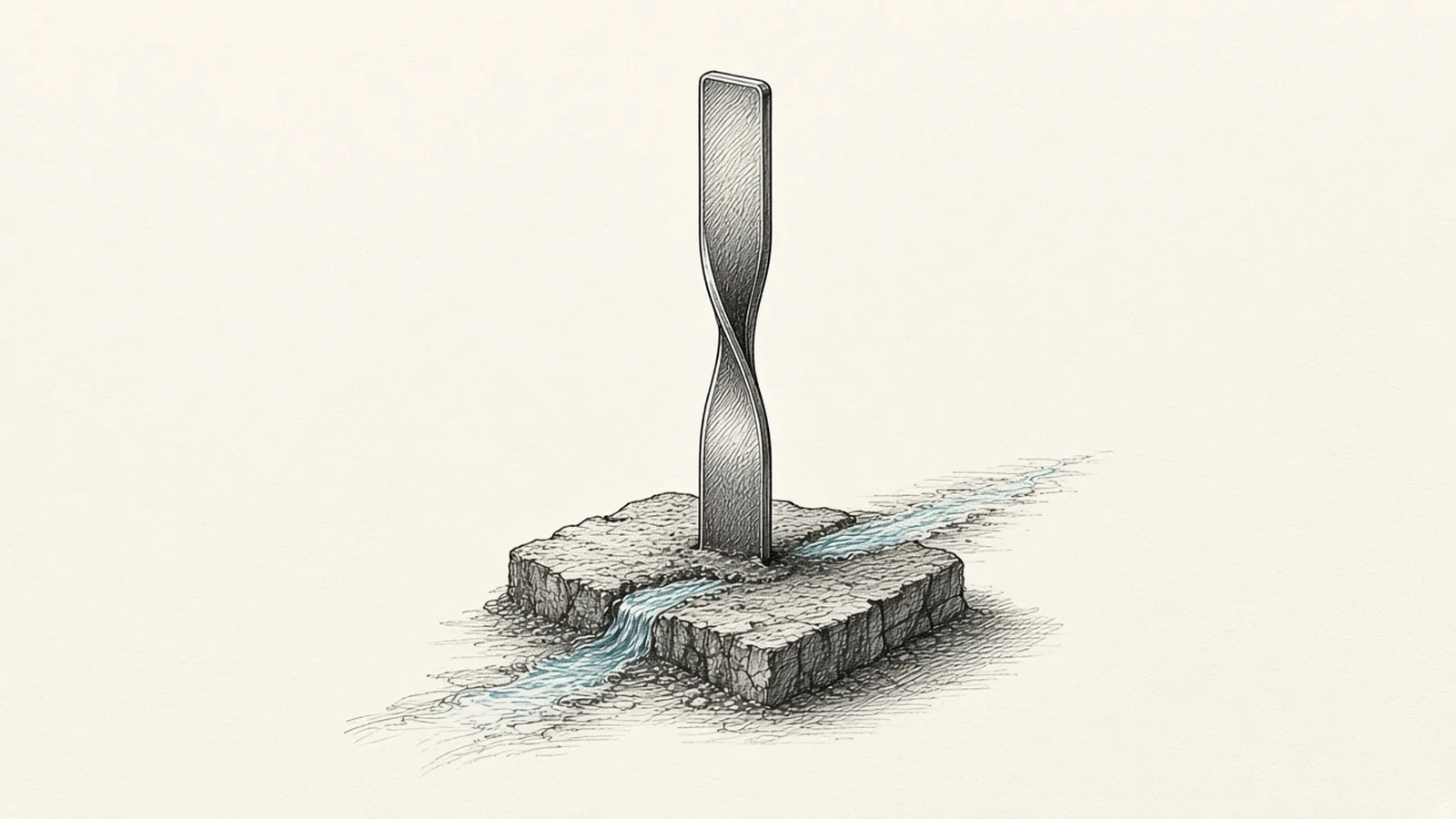
The distortion has a price, though. In a deeper bed the water runs faster than in the real bay. To slow it down, the engineers set about 250,000 copper tabs into the floor, small strips of metal that resist the current. Their number and position did not come from the drawing: they were adjusted during calibration, until the model behaved like the measurements taken outside.
This is the detail that interests me. The model becomes true not because it resembles the bay, but because it was calibrated against it. The Corps itself asks visitors to think of it as a simulator of bay conditions, not as a model of familiar landmarks. A quarter of a million small copper obstacles are the most honest part of the work: the exact point where the builder admits that the copy, on its own, lies.
The water's verdict
In 1960 researchers began running the Reber Plan on the model. John Reber died on 16 October that year, aged 73, before the answer came. The Corps report, published in 1963, concluded that the plan was "infeasible by any frame of reference". The concrete had confirmed what several state studies had already feared. No dam was ever built.
The model worked as a research tool from 1958 to 2000: dredging, water diversions, waste discharges, oil spills. Between 1966 and 1969 the delta of the Sacramento and San Joaquin rivers was added. Today the research department is closed and the shed is a free visitor centre; computer models have taken its place.
What remains is an object that holds together two things we usually keep apart. Like Bill Phillips's MONIAC, which ran coloured water in place of money, the Bay Model shows that a simulation is not an imitation of reality but a pact with it: distort where you must, correct where the distortion betrays you, and let the water decide. The myth, if there is one, lies in a strip of copper the height of a finger, set into concrete to slow a fake sea just enough to make it believable.
Sources: U.S. Army Corps of Engineers, Facts about the Bay Model and History of the Bay Model; Charles Wollenberg, John Reber: The Man Who Helped Save the Bay by Trying to Destroy It, FoundSF; U.S. Army Corps of Engineers Bay Model, Wikipedia (accessed 24 November 2026).
> ln -s ./linked-nodes
- [PART OF] Simulation & Reality
- [RELATED] The Economy Made of Water: Bill Phillips's MONIAC
- [RELATED] The Tide Machine: Kelvin and a Sea Made of Pulleys