Five Dice in a Shoe Box: Diceware and the Password That Doesn't Resemble Us
In 1995 Arnold Reinhold proposed choosing passphrases with five dice and a list of 7,776 words. Thirty years on, even NIST agrees with him.
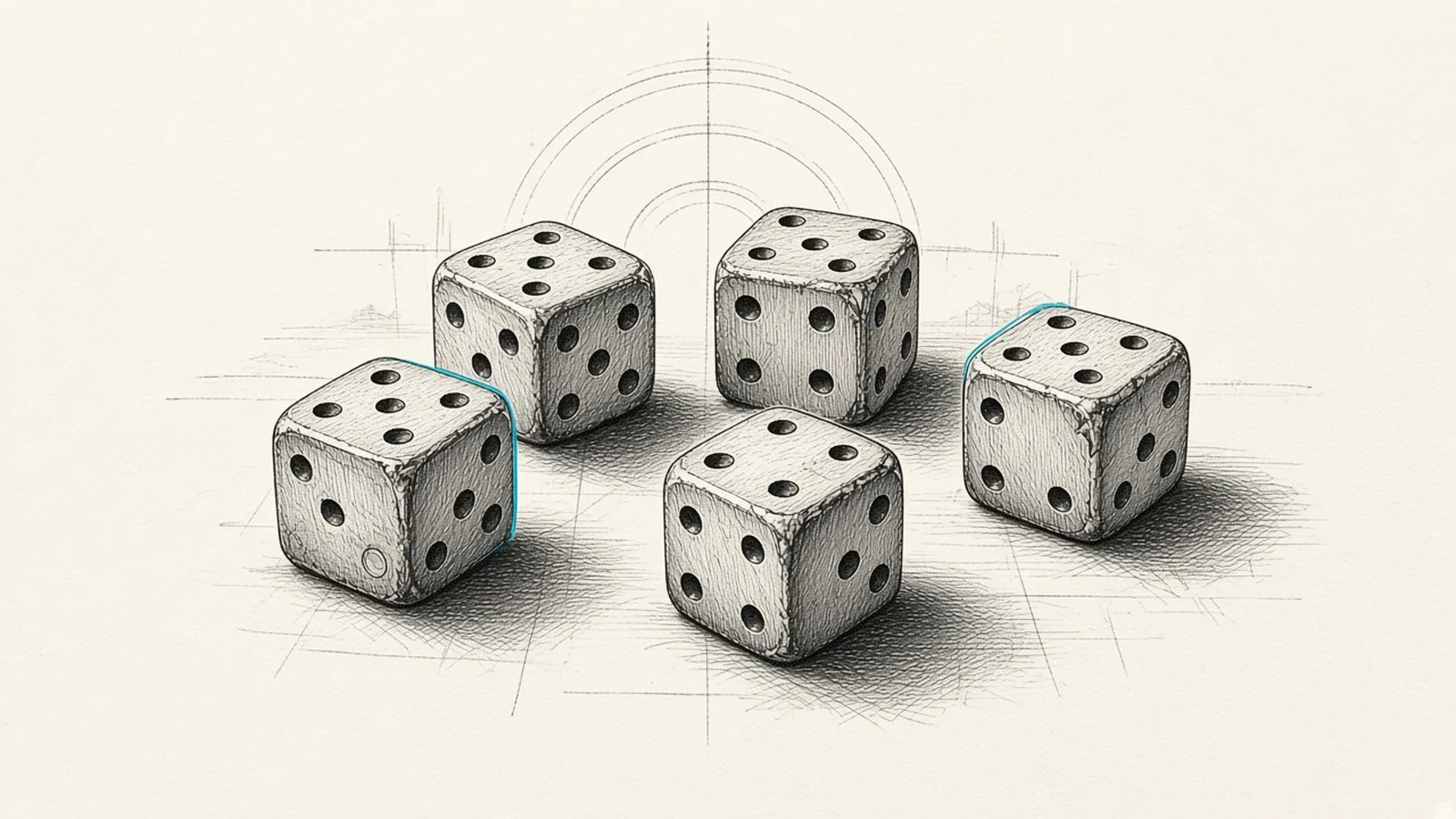
On 28 July 1995 Arnold Reinhold, in Cambridge, Massachusetts, posted a text with a technical-manual title and the contents of a games drawer. He had run a small survey of users of PGP, then the most widespread encryption program, and drawn an awkward conclusion from it: many chose weak passphrases. His answer was not a program. It was a list of words and five dice.
The method is called Diceware. You roll five six-sided dice, read the numbers from left to right and get a five-digit index, from 11111 to 66666. There are 7,776 possible combinations, and the list holds exactly 7,776 short words, each next to its index. You repeat the roll for every word. Reinhold even gave practical instructions: buy a set of dice, which cost $1.49 at a toy store, put them in a clear plastic shoe box, shake it at least ten times, then tip it so the dice slide against one edge.
Chance outside the head
The point of Diceware is not the list, which anyone can read. The point is that the choice does not pass through the mind of the person writing. When we invent a password, we invent it as human beings: a cherished word, a date, a letter swapped for a number. These are the same habits as millions of other people, and attackers know them. A die has no preferences. Each word drawn is worth about 12.9 bits of uncertainty, the base-two logarithm of 7,776, and the security holds even if the adversary knows you used Diceware, knows the list and knows how many words you chose.
In 1995 Reinhold recommended five words. In 2014 he raised the bar to six, because computing power had grown. In 2016 the Electronic Frontier Foundation published new lists, still of 7,776 words, easier to type and to remember. Lists now exist in more than two dozen languages, Italian included.
The rule that got it wrong
In the same years official security was heading another way. In 2003 Bill Burr, at NIST, the US standards institute, wrote an eight-page appendix that became the reference for agencies, universities and companies: irregular capitals, special characters, at least one number, and frequent changes. In 2017, by then retired, he told the Wall Street Journal he regretted much of that advice. People had done what people always do: "P@ssw0rd1", then "P@ssw0rd2".
NIST rewrote the guidance in June 2017. The current version, SP 800-63B-4 of July 2025, is even clearer: it forbids imposing composition rules, forbids mandatory periodic changes, asks for a password to be changed only when there is evidence it was compromised, and sets fifteen characters as the minimum when the password is the only factor. Length and unpredictability, not acrobatics.
That is why I built the Password Policy Checker around a simple question: do the rules we ask for really help, or do they push people toward the same shortcuts? Reinhold's answer was already in the shoe box. A good password is not complicated. It is chosen by something that does not resemble us.
The die is, after all, the oldest object in this story. People threw it to decide what they did not want to decide themselves. Diceware gives it the same job: to take from our habits the task of protecting us, and leave them the task of keeping the result, in a password manager or on paper, as I describe in Security as an Operating Habit.
Sources: A. G. Reinhold, "Diceware for Passphrase Generation and Other Cryptographic Applications", 28 July 1995; Diceware, Wikipedia (accessed 8 November 2026); EFF, "EFF's New Wordlists for Random Passphrases", July 2016; NIST, SP 800-63B-4, July 2025; The Verge, "Best practices for passwords updated after original author regrets his advice", 7 August 2017, reporting Bill Burr's interview with the Wall Street Journal.
> ln -s ./linked-nodes
- [PART OF] Operational Cyberinfrastructure
- [RELATED] Password Policy Checker
- [RELATED] Security as an Operating Habit