The 1919 Plate: Light Bending Beside the Sun
In 1919 two expeditions photographed the stars beside the eclipsed Sun: a glass plate showed light bent by gravity.
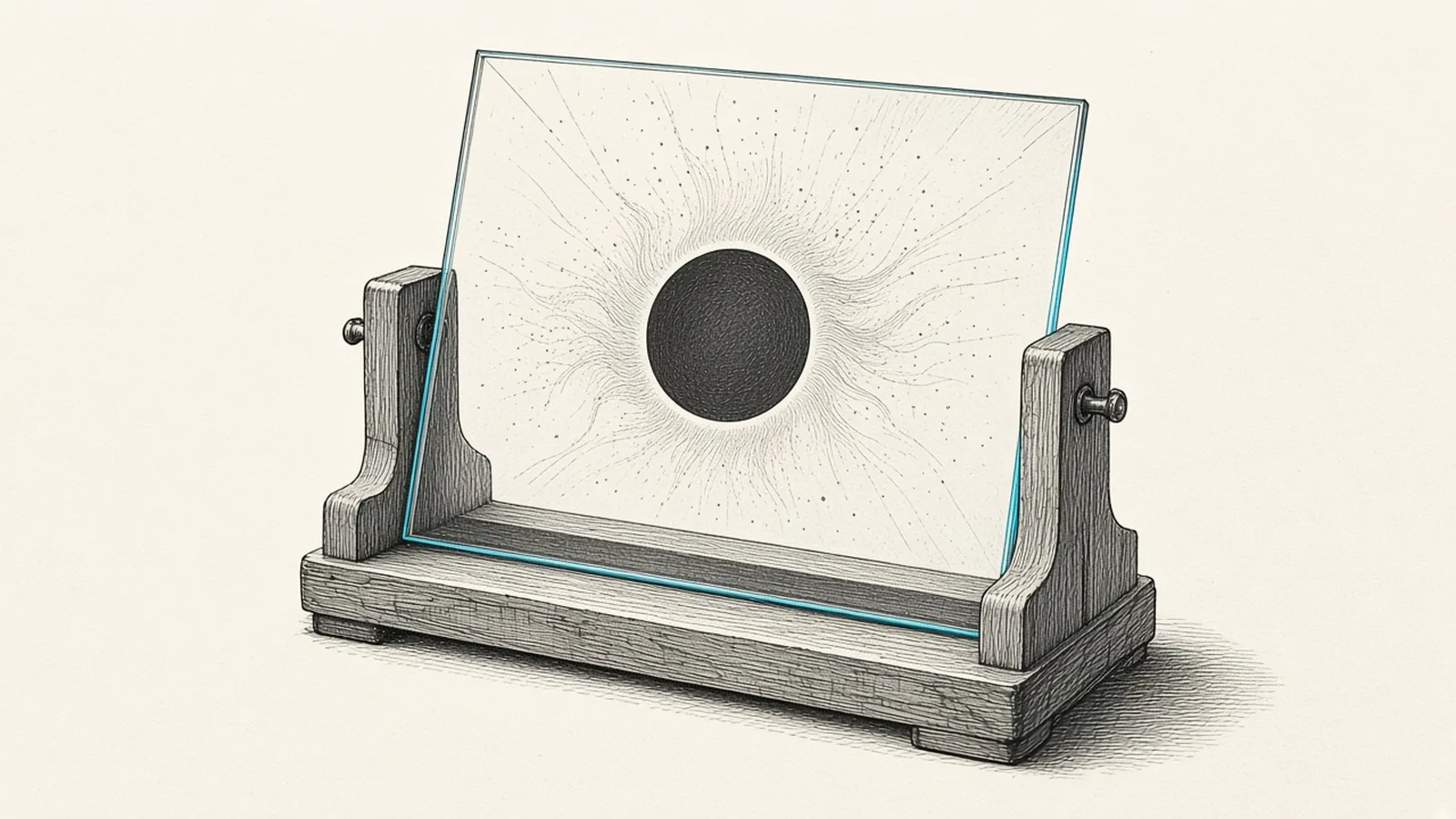
On 29 May 1919 the Sun went dark for a few minutes along a strip that crossed the equator, from South America to Africa. At two points on that strip stood British telescopes aimed not at the Sun but at what lay around it: the stars of the Hyades cluster, which that day formed its background. At Sobral, in north-eastern Brazil, Andrew Crommelin and Charles Davidson of the Greenwich Observatory. On the island of Príncipe, off the coast of West Africa, Arthur Eddington and Edwin Cottingham, of the Cambridge group.
The aim was to measure a tiny shift. According to Einstein's general relativity, a star seen grazing the edge of the Sun should appear displaced by 1.75 seconds of arc, about one two-thousandth of a degree, pushed away from the Sun because its light bends as it passes. A Newtonian calculation, treating light as matter subject to gravity, gave half that. The simplest hypothesis also remained: no shift at all.
A measurement made of glass
The decisive instrument was not the telescope. It was the plate: glass coated with emulsion, on which the stars remain as points. To see the shift, two plates of the same sky had to be compared: one taken during the eclipse, with the Sun in the middle, and one taken at night, when the Sun is elsewhere. The Sobral team came back in July to photograph the same stars before dawn. For Príncipe, the comparison plates had been taken at Oxford in January and February.
The sky was not the same for everyone. On Príncipe the day began with a heavy thunderstorm and cleared just before totality. Eddington telegraphed three words: "Through cloud, hopeful." Of his plates, only two turned out good enough for the measurement. At Sobral the sky was clear, but the plates from the main telescope came out with diffuse, out-of-focus images: the cause was put down to the Sun's heat on the mirror that reflected light into it. A second, smaller lens, four inches across, saved the measurement.
On 6 November 1919, at a joint meeting of the Royal Society and the Royal Astronomical Society, the results were announced: 1.98 seconds of arc from Sobral, 1.61 from Príncipe. The defective plates were discarded, and the report said so openly. In 1979 the original Sobral plates were remeasured with modern machines: the result stayed essentially the same. The glass had kept the proof for sixty years.
A nothing against the whole sky
There is something stern in this story of scale. An enormous mass, the Sun, reveals the shape of spacetime through a deviation of less than two seconds of arc. The cosmos did not show itself as large: it showed itself as precise. And it did so on an object that fits in the hand and breaks if it falls.
Today the same effect has a name that sounds like a legend: gravitational lensing. The Hubble Space Telescope has photographed distant galaxies distorted by the mass of foreground galaxy clusters. The Gaia satellite, which measures the positions of stars, has to allow for the deflection caused by the Sun across the whole sky. What in 1919 was a hypothesis to be tested has become a routine correction.
In the Impossible Lab's Gravitational Lens you move a lens in front of a star field and watch the background warp. The tool states its limits: the thin-lens equation for a point mass, not full relativistic ray tracing. It is a game, but it repeats the question of the plates: what stands between us and the light we look at? It is the same idea as Thinking Against Cosmic Scale: small things do not become useless because the universe is large. They become more precise.
The plate does not say that space is curved. It shows a star out of place by almost nothing, and lets that nothing be the proof.
Sources: F. W. Dyson, A. S. Eddington, C. Davidson, A Determination of the Deflection of Light by the Sun's Gravitational Field, from Observations made at the Total Eclipse of May 29, 1919, Phil. Trans. R. Soc. A 220 (1920); The Observatory 42, no. 545, November 1919 (report of the meeting of 6 November 1919); Nature 103, 1919, "The Solar Eclipse"; R. Catchpole and G. Dolan, General Relativity and the 1919 Solar Eclipse, royalobservatorygreenwich.org; G. M. Harvey, The Observatory 99 (1979).
> ln -s ./linked-nodes
- [PART OF] Cosmic Scale
- [RELATED] Gravitational Lens
- [RELATED] Thinking Against Cosmic Scale