The Eight-Inch Floppy: When a Living System Is Already a Ruin
Until 2019, US nuclear command ran on eight-inch floppy disks. A concrete case of a living system already turned into a ruin of format.
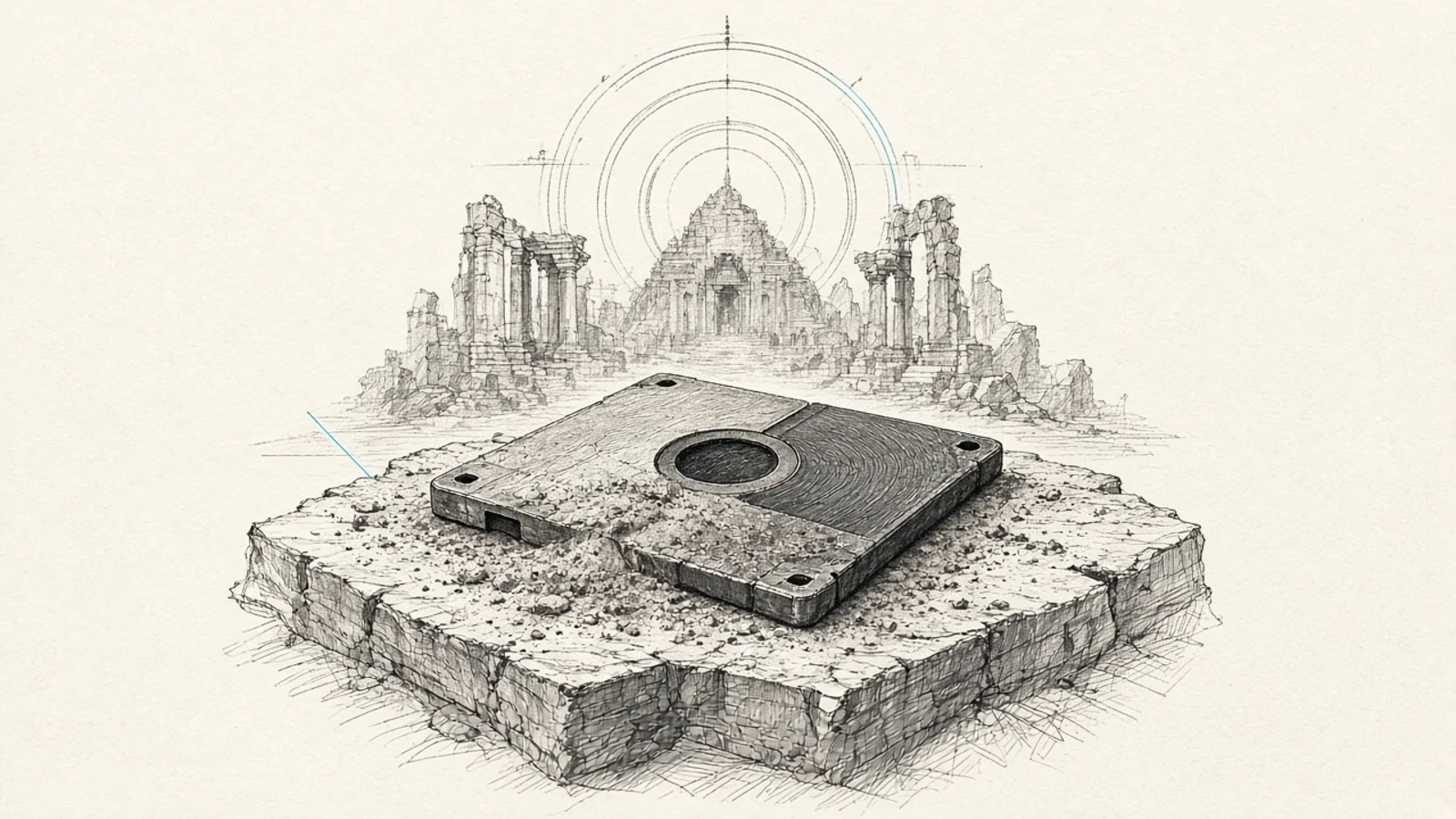
Until 2019, command and control of the US nuclear forces depended on a flat, square object eight inches wide. The Strategic Automated Command and Control System, SACCS, successor to the SACDIN network, still used floppy disks to store critical command, control and communications data. The computer was an IBM Series/1, a machine from the 1970s.
This is not a museum joke. The GAO, in report GAO-16-468 of 25 May 2016, describes it without rhetoric: the system coordinates the operational functions of the nuclear forces, across intercontinental missiles, bombers and tanker aircraft, and it runs on that hardware, with those disks. In 2014 CBS's 60 Minutes had made visible what the technicians already knew.
The old as an advantage
The Air Force replied that the old was also an advantage: a system off the network is harder to breach. The argument is not foolish, but it is incomplete. It turns the impossibility of upgrading into a theology of security.
Meanwhile the GAO certified the delay. The media upgrade was planned for fiscal year 2017 and the floppies stayed. Spare parts could no longer be found. When something broke, it was repaired: soldering, hours under the microscope, civilians who still had the hands for that work, enlisted programmers writing code for a machine older than themselves. The eight-inch disk was no longer in production. The key to command was already archaeology while command was still switched on.
The threshold changes format
In June 2019 the floppies were retired. In their place, the commander of the 595th Strategic Communications Squadron said, came a highly secure solid-state digital memory solution. The Series/1 machines stayed. The world was not replaced: the medium was. The threshold did not disappear, it changed format.
This is a case, not a metaphor. Whoever arrived afterwards, without the reader, without the solderers, without the chain of civilians who repair what industry no longer makes, would have found a command room and a flat, square, unreadable object. They could have called it a relic, an amulet, a key. They would not have been entirely wrong. They would only have lost the manual.
The grammar, not the surprise
The point is not to mock the Pentagon. The point is the grammar. A living system can already be a ruin of format: power remains, legibility leaves first. For a while, security coincides with the inability to upgrade. Then the medium disappears, and that form of security disappears with it.
What remains is the question nuclear weapons had already posed and the floppy makes concrete: do we still know how to switch off and on again what we have built, or do we only know how to keep an object that one day nobody will know how to insert?
It is the empirical case around which part of my book Reboot — When civilizations forget their own machines, forthcoming, revolves.
Sources: CBS 60 Minutes, 2014; U.S. Government Accountability Office, GAO-16-468, Information Technology: Federal Agencies Need to Address Aging Legacy Systems, 25 May 2016; floppy retirement from SACCS in June 2019, stated by the 595th Strategic Communications Squadron (Offutt) and reported by C4ISRNET and Ars Technica, October 2019.
> ln -s ./linked-nodes