Henrietta Leavitt's Rhythm: the Stars That Measure Distance
Comparing photographic plates of the Small Magellanic Cloud, Henrietta Leavitt found that the rhythm of certain stars reveals how far away they are.
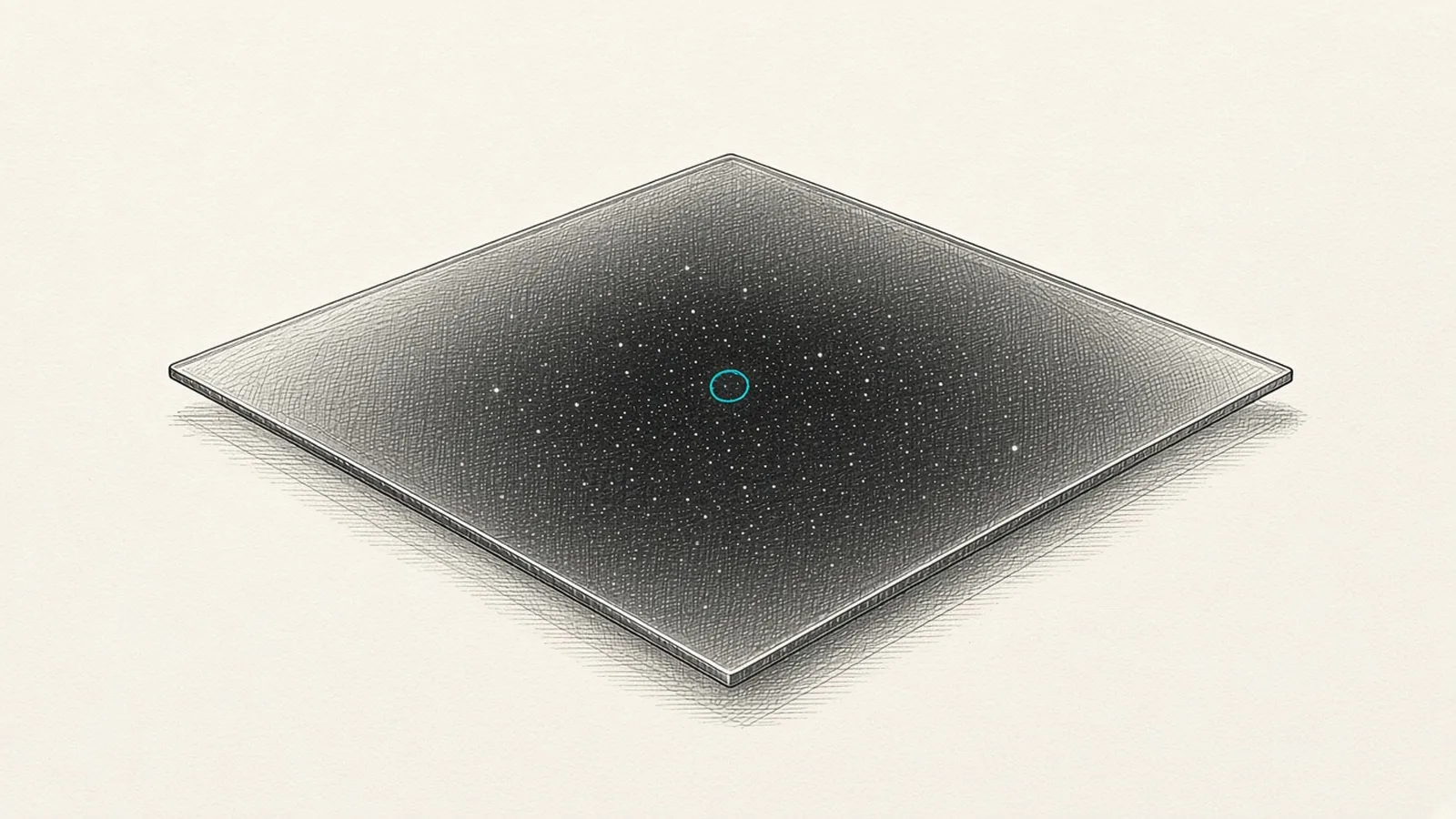
In 1893 Henrietta Swan Leavitt joined the Harvard College Observatory as a volunteer. Edward Pickering, the director, gave her a job with nothing heroic about it: recording the brightness of stars on glass photographic plates and looking for the ones that changed. In 1902 the position became full time. Her instrument was not a telescope but comparison: two plates of the same patch of sky, taken on different nights, looked at side by side until a dot gave itself away by being brighter or fainter than the last time.
The patch of sky was the Small Magellanic Cloud. In the spring of 1904, comparing two photographs brought out a number of faint variables. To measure their periods a series of sixteen plates was taken, with exposures of two to four hours, and they reached Cambridge in January 1905. A single one of those plates, set beside an older one, immediately revealed an extraordinary number of new variables. In the catalogue published in the observatory's Annals, the variables of the two Clouds numbered 1777.
A sentence at the end of a catalogue
At the end of that catalogue Leavitt placed a table of sixteen stars, with their periods and magnitudes, and a single sentence: it is worthy of notice that the brighter variables have the longer periods. She drew no conclusions. Sixteen stars, she later wrote, had seemed too few to warrant them.
She kept measuring. On 3 March 1912 the observatory's Circular 173, signed by Pickering but prepared, as the text itself says, by "Miss Leavitt", gave the periods of 25 variables in the Small Cloud. Plotted against the logarithm of the period, the points fell along a straight line: the logarithm of the period increased by about 0.48 for each magnitude of extra brightness. And there was the reason that line mattered. The stars of the Cloud are probably all at nearly the same distance from us, she wrote; so their period depends on the light they actually emit, not on how far away they seem.
Rhythm as distance
A star that pulses with a certain period has a certain true luminosity. Compare it with the light that reaches us and you get its distance. Only a calibration was missing, and a year later Ejnar Hertzsprung supplied it by measuring the distance of a few Cepheids in our galaxy with parallax. From then on these stars were astronomy's first "standard candles", and since 2008 the relation has carried the name of Leavitt's law. After her death in 1921, Edwin Hubble used it to measure the distances of galaxies and, together with the spectral shifts measured by Vesto Slipher, to show that the universe is expanding.
What strikes me is that the object all this starts from is a sheet of glass looked at closely, beside another one. Nobody in that room saw stars: they saw silver specks, wider or narrower, and the time that passed between one plate and the next. To measure the sky it first had to be turned into an archive, and then someone had to have the patience to read it. Like Eratosthenes' stick in Alexandria, this too is an enormous measure drawn from a tiny gesture. In the essay Thinking Against Cosmic Scale this is exactly what I look for: not bewilderment before distances, but the patient work that makes them thinkable. Leavitt's sky is no larger than ours. It was simply looked at for longer.
Sources: Wolbach Library, Harvard-Smithsonian Center for Astrophysics, Henrietta Swan Leavitt: Variable Stars; The Harvard Plate Stacks, Henrietta Swan Leavitt; H. S. Leavitt and E. C. Pickering, Periods of 25 Variable Stars in the Small Magellanic Cloud, Harvard College Observatory Circular 173, 1912 (accessed 28 October 2026).
> ln -s ./linked-nodes
- [PART OF] Cosmic Scale
- [RELATED] Thinking Against Cosmic Scale
- [RELATED] The Stick of Alexandria: How Eratosthenes Measured the Earth
- [REFERENCED BY] The Lens Cut in Two: Bessel and the First Distance to a Star