The ruins are not silent
Ruins still speak, but perhaps not in the language we think. Reboot starts from the idea that every technical remnant can become myth once it loses its own context.
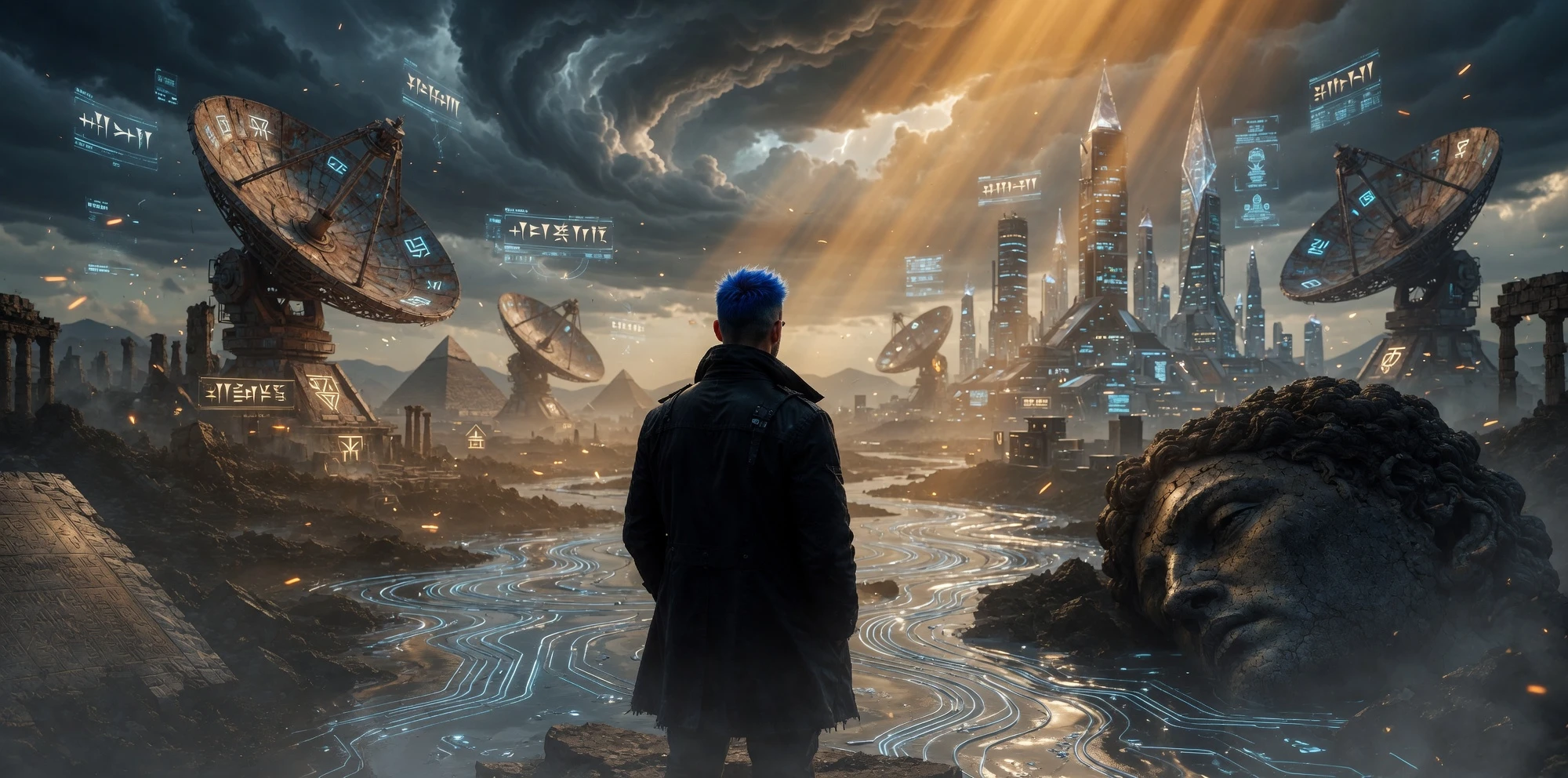
A ruin is a machine that has lost its manual.
This is one of the central images of Reboot. Not because every ruin should be read as a hidden technological device, but because every ruin carries a technical question: what was it for? Who built it? With which tools? For which system of belief, power or survival?
When the context disappears, the form remains. And the form starts to generate myth.
The persistence of stories
The pyramids are still there. Sunken cities continue to inhabit the imagination. The Tower of Babel tells of a civilization that builds upward and then loses its common tongue. The deluge appears across different cultures as the memory of an erasure. Atlantis — whether history, allegory or pure invention — keeps working as the image of a powerful civilization swallowed by its own grandeur.
These stories do not need to be literal proof to matter. Their value lies in their persistence. They return because they touch a deep fear: that civilization can lose itself and leave behind objects more resistant than memory.
Human memory is fragile. Building something is not enough for its meaning to survive. A continuous chain of interpretation is needed: language, school, archives, masters, maintainers, rituals, institutions. When that chain breaks, the material world remains, but it becomes opaque.
A data center two thousand years from now
Imagine a data center two thousand years from now, emptied of its function. Vast halls, modular corridors, cooling systems, metal racks, cables, repeated geometries. Without electricity, without the internet, without knowledge of the protocols, what would it be? A tomb? A temple? A fortress? A sacred place devoted to a god of memory?
It is not such an absurd fantasy. Archaeology is often the art of interpreting infrastructures with no more access to the systems that once made them obvious.
We look at ancient ruins and see mystery. But perhaps their builders saw logistics, administration, social energy, political power, calendar, organized work. What is operational for one civilization becomes symbolic for another.
This passage is the heart of technological mythology.
When a technology becomes an image
A technology is clear only as long as it lives inside the world that knows how to use it. As soon as that world falls, the technology becomes image. It no longer has to function in order to mean. On the contrary, it often means more precisely because it no longer works.
A broken object can become more powerful than a working one. Because it stops answering and starts asking.
The ruins are not silent. They speak through what is missing. They say: here there was an order. Here someone knew how to do something. Here a civilization concentrated energy, faith, technique, hierarchy, desire. But they do not say everything. They leave room for projection.
That is where myth is born.
In Reboot, ruins are degraded memories. Not necessarily lies, not necessarily truth. They are signals that have survived the collapse of the system that made them readable.
Perhaps myth is precisely this: information that has lost its original format, but not its emotional force.
What about us?
And so the question shifts onto us.
What of our machines will stay readable? What will become incomprehensible? What will be venerated, feared, misunderstood? Will a fallen satellite be seen as a captured star? A hardware key as an amulet? A server hall as a ritual chamber? A technical manual as a forbidden text?
Every civilization leaves ruins. But not all of them leave instructions.
And perhaps the destiny of a civilization is measured not only by what it builds, but by how much it manages to keep readable of what it leaves behind.
> ln -s ./linked-nodes
- [PART OF] The Machine, the System, the Eras, the Frequency, the AI
- [PART OF] Technological Mythology
- [REFERENCED BY] The Machine, the System, the Eras, the Frequency, the AI