Three Pegs and One Rule: the Tower of Hanoi as Procedure
In 1883 Édouard Lucas sold three pegs and a stack of disks. Three rules, 2ⁿ − 1 moves: recursion taught with a piece of wood.
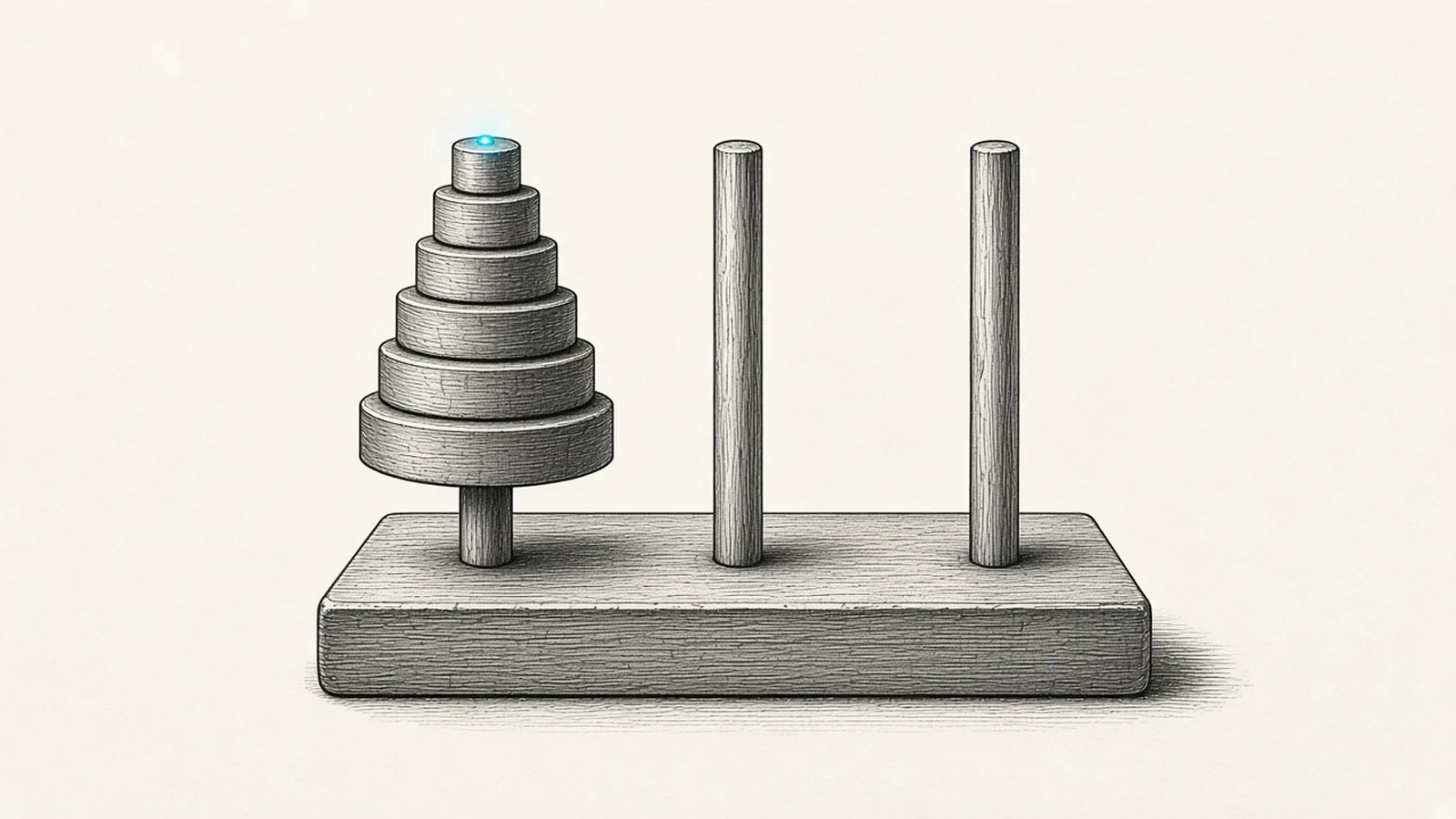
In 1883, in Paris, the mathematician Édouard Lucas put a wooden game on sale with three pegs and a stack of pierced disks, presenting it as an Annamite puzzle recovered by one «N. Claus (de Siam)» — an anagram of Lucas d'Amiens. It was not an artefact from Tonkin: it was an object invented at a desk, with three rules printed on the prospectus. Only one disk may be moved at a time. Always take the top disk of a stack. Never place a disk on a smaller one.
The object is trivial: three rods, disks of decreasing diameter. The procedure is not. To move n disks from one peg to another takes, in the optimal case, exactly 2n − 1 moves. With three disks that is seven. With sixty-four, the number Lucas offered as an impossible wager, it is 18,446,744,073,709,551,615. At one move per second, more than five billion centuries.
The legend fastened to the wood
In the booklet that came with the game, Lucas told of a temple in Benares where Brahmins moved sixty-four golden disks on diamond needles. When the last disk left the first needle, the world would end. It was ornament, not a source. The point was not the myth: it was that the myth stayed fastened to the object, like a label of instructions. Whoever held the three pegs also held the time of the world reduced to a recurrence.
Builders recognise the shape. A short, repeatable rule that admits no local shortcuts: to free the large disk you must first move the entire smaller tower onto the spare peg, then move the large one, then bring the small tower back on top of it. Recursion taught with the hands. No machine is required: only the acceptance that the problem of n is twice the problem of n − 1, plus one step.
A check that does not lie
In the builder's operating system, useful checks are the ones that cannot be talked into anything. The Tower of Hanoi does not negotiate. Put a large disk on a small one and you have broken the rule; skip a step of the recursion and the tower does not arrive. There is no way to «almost» solve it. That is why, for more than a century, it has remained the exercise that shows a complete procedure can fit in three sentences and a piece of wood.
On the site I leave a tool that runs those moves: choose N, start, watch the log. It invents nothing. It counts to 2n − 1 and places the disks where they must go. Lucas's object was already a program; the screen only makes it readable without the fingers.
Three pegs, one rule about diameter, one recurrence. A builder needs no more than this to remember that a serious algorithm is, first of all, a discipline of order: do not take the large step until the small tower is elsewhere.
Sources: Édouard Lucas (as N. Claus de Siam), La Tour d'Hanoï, 1883; Henri de Parville, Journal des débats, 27 December 1883; Tower of Hanoi, Wikipedia; MacTutor, The Towers of Hanoi (accessed 6 November 2026).
> ln -s ./linked-nodes
- [PART OF] Builder Operating System
- [RELATED] Tower of Hanoi
- [RELATED] The Builder Operating System