The Stud in the Ankle: Talos, the Bronze Guardian of Crete
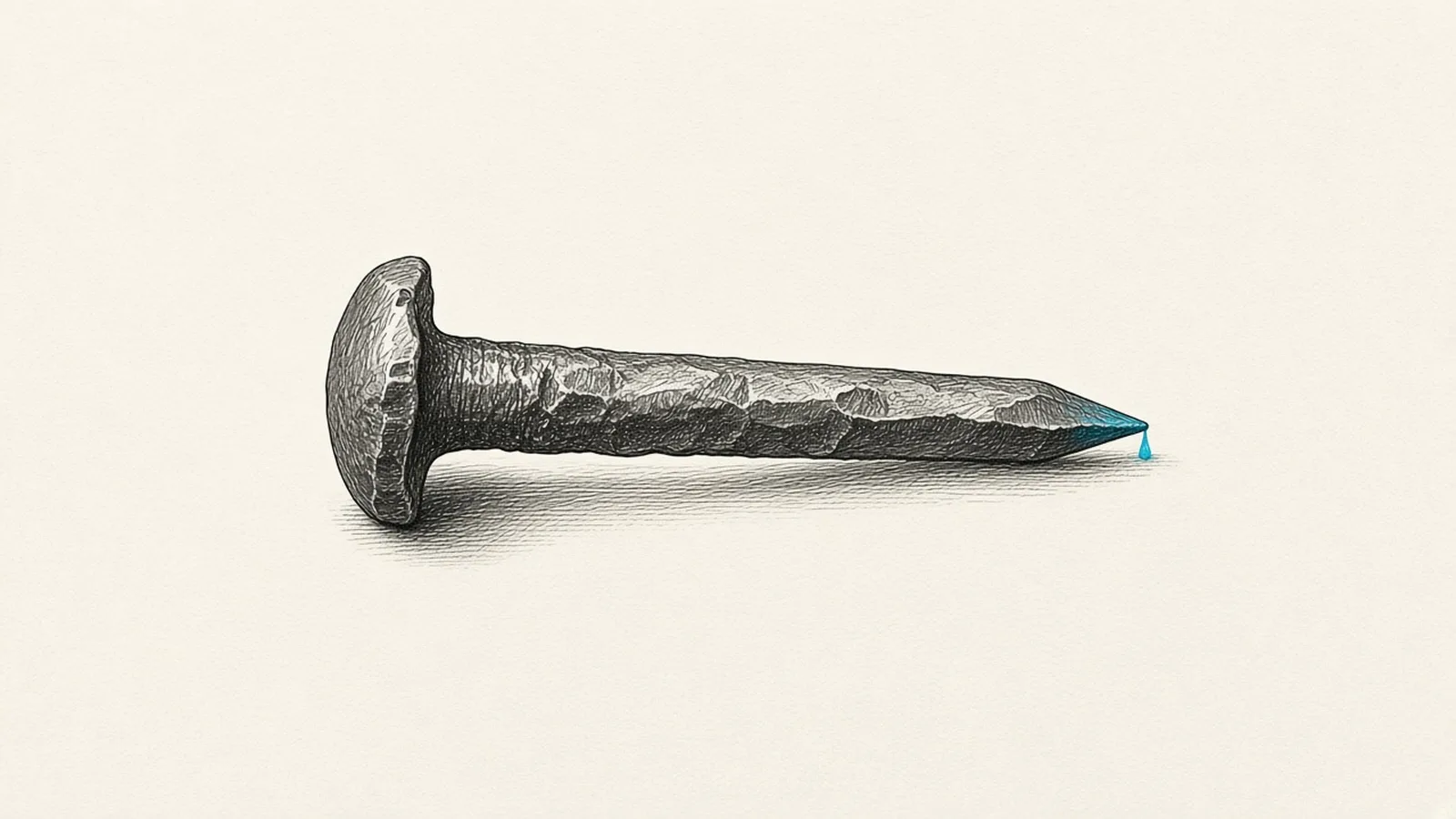
Talos ran round Crete three times a day, invulnerable except at one point: a single vein closed by a bronze stud.
In the fourth book of the Argonautica, written by Apollonius of Rhodes in the third century BC, the Argo reaches Crete exhausted. It seeks shelter in the harbour of Dikte and cannot make fast to the shore. From the cliff a giant of bronze breaks off lumps of rock and hurls them at the hull. His name is Talos. Zeus gave him to Europa to keep watch over the island, and Talos does it in the simplest possible way: he runs round its coast on his bronze feet, three times a day.
The poet adds a detail that might have come from a technical manual. His body and limbs are bronze and invulnerable, except at one point: under a sinew by his ankle runs a blood-red vein protected only by a thin skin. There, Apollonius writes, lie life and death.
One vein, one stud
The Library attributed to Apollodorus, a mythographic handbook written some centuries later, makes the detail even more concrete. Talos has a single blood vessel running from his neck down to his ankles, and its lower end is held shut by a bronze stud. The giant runs round the island three times a day as a security patrol, and when he sees the Argo approaching he throws stones.
On his end the versions diverge, and the divergence is instructive. Some say Medea drives him mad with drugs. Others say she promises to make him immortal and, on that pretext, removes the stud: all his ichor flows out and Talos dies. Others still say an arrow from Poeas in the ankle was enough. In the Argonautica Medea bewitches him with her gaze from a distance, and the giant, while hoisting stones to keep the ship from anchoring, grazes his ankle on a sharp rock: the ichor runs out like molten lead, and he comes down like a half-felled pine that the night wind finishes off.
Plato, in the dialogue Minos, keeps another image under the same name. Talos makes a round of the villages of Crete three times a year as guardian of the laws, carrying the laws inscribed on bronze tablets: that, the text says, is why he was called "brazen". Guardian of the perimeter and guardian of the rules: the same figure has two jobs.
The point where it opens
The myth, here, explains nothing. It touches an object: a bronze stud, driven into the end of a vein. It is the smallest part of the giant and the only one that matters. Everything else, the tireless running, the stones, the invulnerable skin, rests on that plug.
Anyone who looks after systems today recognises the shape without translation. A defence that circles the perimeter all day, powerful and visible, with a single closure on which everything depends. And above all the way it falls in the Library's version: not under assault, but through a promise. Medea does not break the bronze; she offers something the guardian wants, and the guardian lets her pull out the stud. It is the grammar of many modern intrusions, where the door is not forced: it is talked open.
The essay When Technology Becomes Myth describes how tools turn into symbols. Talos travels the other way: an ancient symbol that, reread, becomes a tool again, almost a review checklist. The Antikythera mechanism shows that the Greeks really could build bronze gearwork; Talos shows they could already imagine where such a device would open. In the Technological Mythology theme this small lesson remains: in front of every guardian, ask where its stud is, and who might persuade it to pull it out.
Sources: Apollonius of Rhodes, Argonautica 4.1638 ff.; Pseudo-Apollodorus, Library 1.140 (1.9.26), both as collected by Theoi Project, Talos (accessed 21 November 2026); Plato, Minos 320c, trans. W. R. M. Lamb, Perseus Digital Library.
> ln -s ./linked-nodes
- [PART OF] Technological Mythology
- [RELATED] When Technology Becomes Myth
- [RELATED] The Lump of Bronze: The Antikythera Mechanism and Its Counted Teeth