Rømer's Eleven Minutes: The Moon of Jupiter That Arrived Late
In 1676 Ole Rømer noticed that Io's eclipses came late when the Earth moved away from Jupiter. Light had a speed.
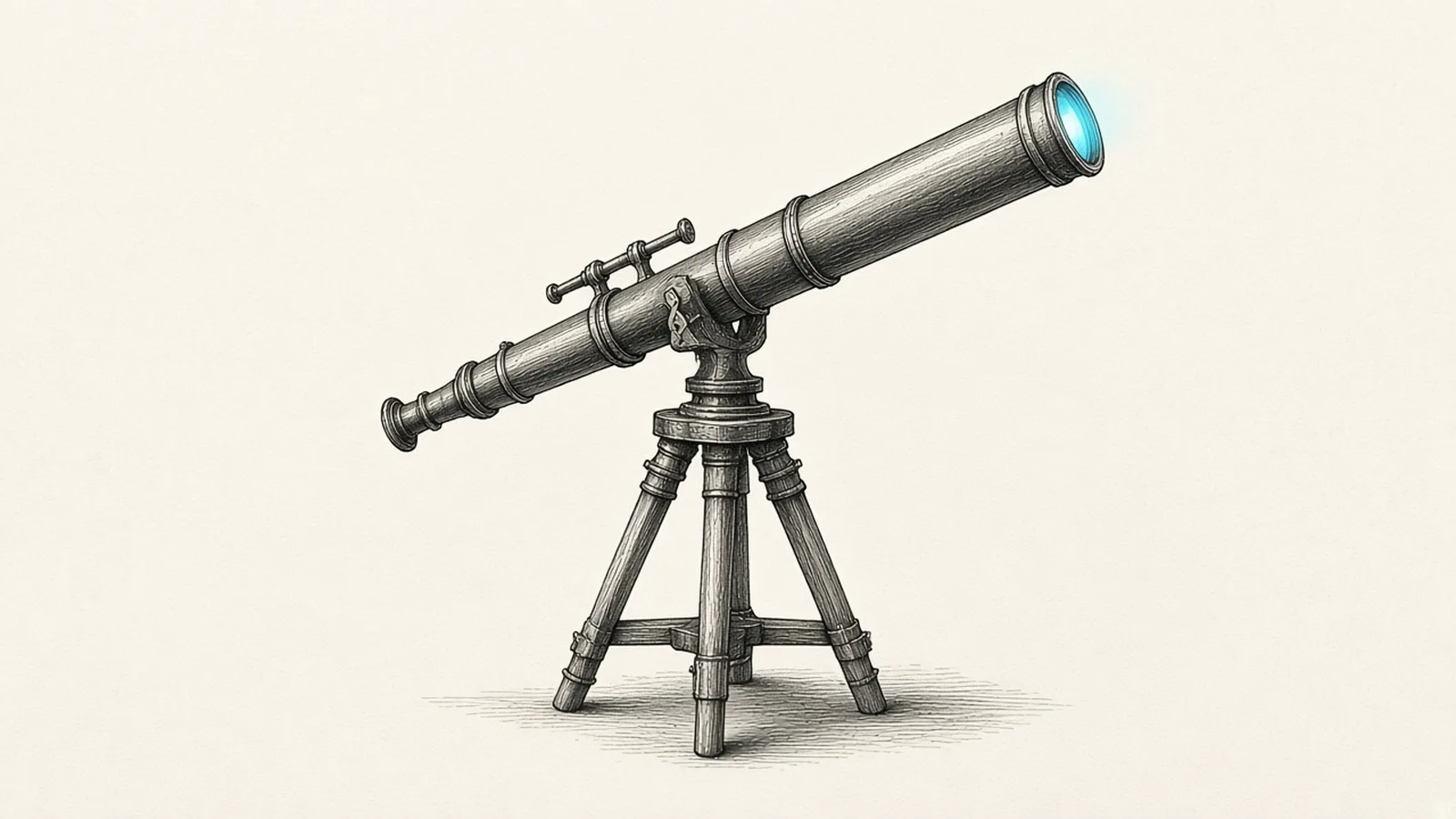
In the summer of 1676 a young Danish astronomer, Ole Rømer, was working at the Royal Observatory in Paris. His task looked modest: timing the eclipses of Io, the innermost of the moons of Jupiter that Galileo discovered in 1610. Io circles the planet in about forty-two and a half hours and on every orbit it passes into Jupiter's shadow. From Earth it can be seen to vanish suddenly, or to reappear. For seventeenth-century astronomers it was a clock hung in the sky: the eclipse tables prepared by Giovanni Domenico Cassini, the Observatory's director, were used to determine longitude.
But the clock was not regular. For years Rømer had recorded timings that did not add up: when the Earth, in its orbit, was moving away from Jupiter, the interval between one eclipse and the next grew longer; when it was moving closer, it grew shorter. In spring 1672 the difference between two periods measured a few weeks apart was only thirty-two seconds, but added up over thirty orbits it made an emergence of Io arrive a quarter of an hour later than predicted.
A prediction with a delay inside it
Rømer did not think Io was slowing down. He thought the road was changing. If light takes time to travel, every eclipse seen from a more distant Earth arrives a little late, like a letter posted from a country that is moving away. On 22 August 1676 Cassini announced to the Academy of Sciences that he would change the basis of his tables, and a prediction was made public: the emergence of Io in mid-November would be seen about ten minutes later than the old method gave. On 9 November a late emergence was observed. On 21 November Rømer explained his calculation to the Academy; on 7 December the Journal des sçavans reported it.
The estimate was this: about eleven minutes for light to cover the distance from the Sun to the Earth, twenty-two to cross the whole of Earth's orbit. Today we know it is a little over eight. The error came mostly from the orbit of Jupiter, which Rømer knew poorly. But the exact number was not the point. The point was that there was a number at all: light does not arrive at once.
The sky arrives late
Cassini never fully accepted the idea. The other moons of Jupiter did not show the same effect clearly, and there were irregularities the delay did not explain. Christiaan Huygens, on the other hand, supported it at once, and in his Traité de la lumière he derived from it a speed of more than a hundred million toises per second. Newton, in his 1704 Opticks, wrote seven or eight minutes from the Sun to the Earth. Final confirmation came only with James Bradley and stellar aberration in 1729, nearly twenty years after Rømer's death. Most of his papers burned in the Copenhagen fire of 1728; one sheet with some sixty observations of Io survived and was found again in 1913.
In the essay Thinking Against Cosmic Scale I write that the cosmos is not only large, it is asynchronous: a signal can travel for a long time and arrive when whoever sent it no longer exists. Rømer found the first proof of it with a telescope and a log of timings. After him, everything we look at in the sky carries a date: we see Jupiter as it was some tens of minutes ago, and the stars measured by Bessel with his split lens as they were years ago. A small moon that showed up late taught us that looking far away also means looking back.
Sources: Wikipedia, Rømer's determination of the speed of light (accessed 3 November 2026), citing L. Bobis and J. Lequeux, "Cassini, Rømer and the velocity of light", Journal of Astronomical History and Heritage 11(2), 2008, and the report in the Journal des sçavans, 7 December 1676.
> ln -s ./linked-nodes
- [PART OF] Cosmic Scale
- [RELATED] Thinking Against Cosmic Scale
- [RELATED] The Lens Cut in Two: Bessel and the First Distance to a Star