Codex · IV.7 · LORE ARCHIVE
The Xdripian Layer
How the narrative of Tales of Xdripia takes shape — one world, many forms.
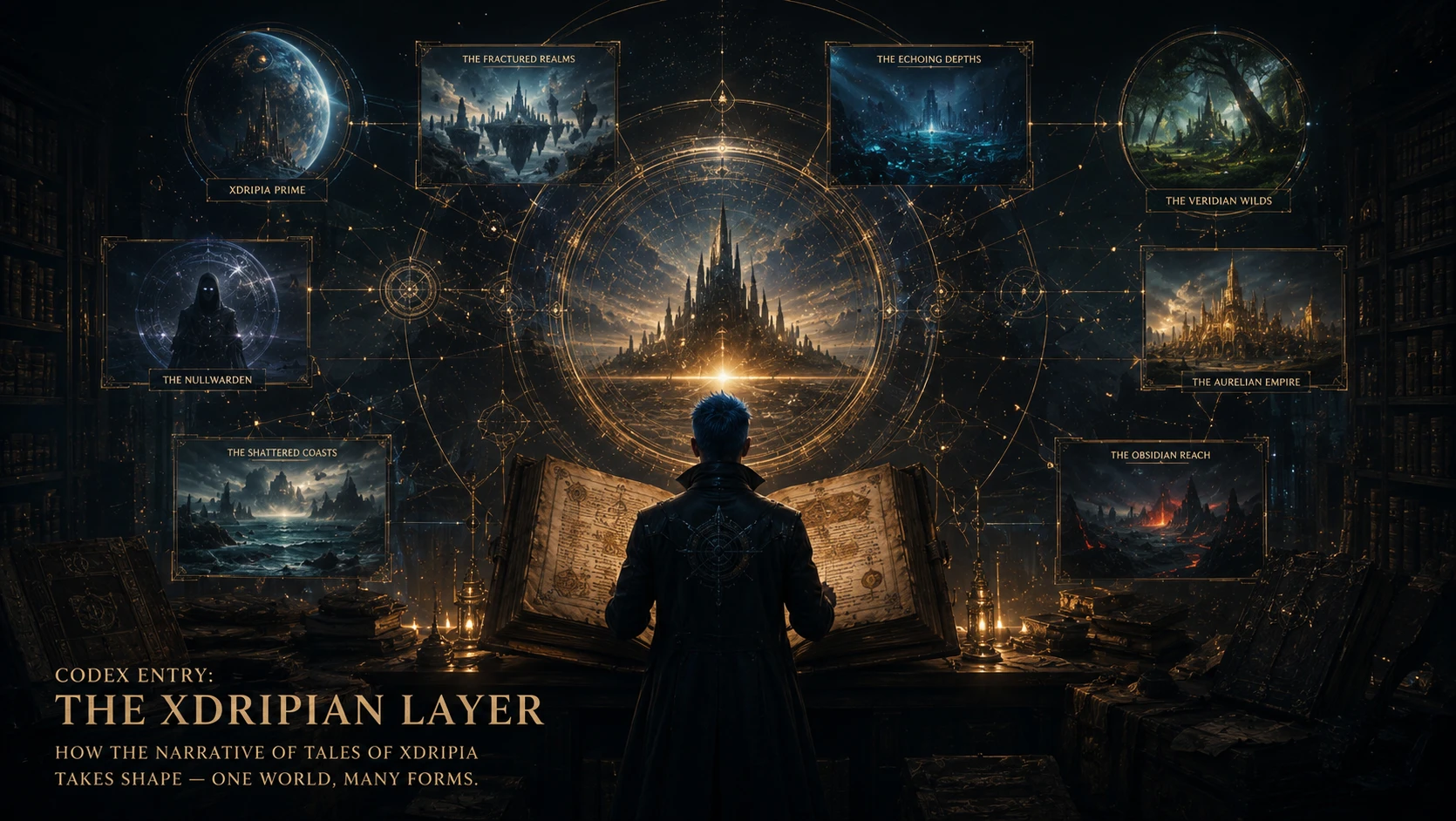
Every world worth visiting is born twice. The first birth happens in the mind of the person who imagines it, and that birth is silent, almost private. The second happens when the world decides not to stay still — when it begins to ask for voices, images, sounds, objects, and hands that can touch it from different angles. It is in that second birth that Tales of Xdripia found its shape. And it is worth explaining how.
When Xdripia is described as a "multimedia universe", there is a risk of evoking the image of a product spread across several platforms — the film, the game, the book, the merchandise — as if they were translated copies of the same story. That is not how Xdripia works. Xdripia is not distributed across formats: it lives in different formats, each one telling a part of the world the others could not tell.
One lore, many forms
At the center of everything is a single narrative fabric. The Seven Celestial Amulets, the Titans, the Architects, the Primordial Metal that supports the economy of the lands, the fifteen schools of magic, the Wayfarers who cross the eras. It is material that exists as a coherent core, held inside an archive we call the Codex.
From that core, the formats branch outward. But — and this is the first law of our method — the formats do not illustrate the lore. They interrogate it.
A video game is not the lore "turned into gameplay". It is the lore seen by those who fight it: in the hands of a player, Xdripia becomes the world that resists, that pushes back, that demands dexterity and choice. A piece of music is not the lore "set to music". It is the lore heard from within: what you hear while sitting in an alley of a city in the world, while someone, somewhere, sings about something that happened a very long time ago. A book is not the lore "told". It is the lore remembered — with all the errors, omissions, and inventions that memory carries with it.
Every format is an angle of view. And every angle reveals things the others cannot see.
The world before the story
The second law of our method is less intuitive, but perhaps the most important: the world comes before the story.
Many narrative projects begin with the protagonist. A character is imagined, an arc is built, and then a setting is decorated around them to hold it all together. We do the opposite. Xdripia existed before its heroes, and it will continue to exist when their names have turned to dust. That is why, when we invent a character, we do not ask what they will do. We ask what the world has already done to them — what inheritances they carry, what debts, what Seals, what memories that are not theirs but belong to those who came before.
It is a choice with precise consequences. It means every story in Xdripia has roots deeper than its plot. It means an object found in a dungeon has a biography that predates the player by centuries. It means an enemy defeated in a few seconds belongs to a lineage, a language, a rite.
Systems that become myth
There is a third law, and it concerns the way we treat mechanisms. In Xdripia, there are no abstract systems floating above the world. Every mechanism — an economy, a value chain, a property register, a communication network — is embodied. It becomes place, order, conflict, rite.
A coin is not only a unit of exchange: it is an object minted by someone, at a specific time, for reasons someone still remembers. A title of ownership is not only certification: it is a Seal, something carried on the body, something the world recognizes, something that can be lost in ways that are not merely administrative. An archive is not only preservation: it is a physical place, guarded, contested, sometimes raided.
This choice comes from a conviction: anything that remains only abstract disappears in narrative. Anything embodied remains. And a world that remains is a world the community can inhabit.
The community as co-narrator
And this is where the fourth law arrives, the one that makes Xdripia different from many universes built from above. We do not write to be consumed. We write to be continued.
The Codex is an archive, but it is an open archive. It grows with the voices that enter it. Every reader who becomes invested, every player who explores, every listener who deciphers a reference inside a track is participating in an act that, in Xdripia, has a precise name: weaving their own story among the stars. The phrase sounds rhetorical only until it is taken seriously. We take it seriously. It means we leave cracks in the walls of the lore — places where other voices can enter, fragments that are never fully closed, signals waiting for someone to interpret them.
The code voice
Code voice is the name we give to these openings. They are not behind the scenes — they are part of the world itself. They explain the method from within: how Xdripia thinks, how it remembers, how it allows itself to be crossed by those who encounter it.
Tales of Xdripia, in the end, is not a saga that tells itself. It is a world that invites itself to be told. For those who choose to enter it, that difference will be everything.
— Open fragment. The archive continues.